

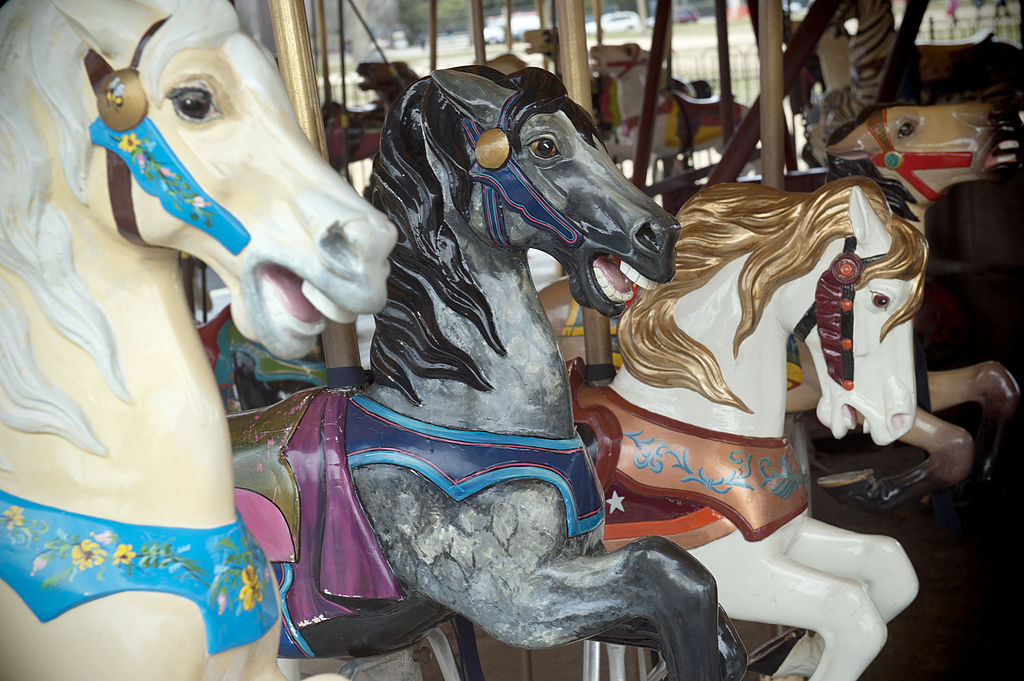
American manufacturing and civil rights detail the history of this fixture of the National Mall.
After nearly three years of renovations, and in time for the America 250 celebrations, the Smithsonian Carousel reopened in April 2026 after a lengthy restoration process. While this carousel is known for bringing joy to the National Mall with its childhood nostalgia – and a reprieve for sightseeing families with young kids – it also has a rich history in both American manufacturing and civil rights.
The original Smithsonian Carousel was placed in April 1967 as part of a series of efforts to make the National Mall more inviting for both visitors and residents alike – the same effort that brought about the Smithsonian Folklife Festival. The carousel, meant to be a “living extension” of the Smithsonian, was not brand new; It had been manufactured in Tonawanda, New York, by the Allan Herschell Company in 1922.
That was founder Allan Herschell’s fourth carousel manufacturing company, a business created over 3,000 carousels and outproduced every comparable rival in its day. The company’s upstate New York location allowed Herschell to source lumber from along the Niagara River to hand-carve basswood horses while manufacturing his own steam boilers, which propelled early carousels. Producing everything in-house, the factory contained carving, woodworking, paint, strong, upholstery and machine shops. This allowed the Allan Herschell Company to become a massive employer for both native New Yorkers and European immigrants seeking the American Dream.
The original Allan Herschell Company no longer exists (it merged with rival Chance Manufacturing in Wichita, Kansas in the 1970s), but the original factory site is still preserved in North Tonawanda. It now stands as the Herschell Carrousel Factory Museum on Thompson Street for visitors to experience the former industrial manufacturing hub.
You don’t have to travel all the way to Tonawanda to appreciate what it produced, though; you can admire it in front of the Smithsonian’s Arts and Industries Building, where the Smithsonian Carousel resides. The renovated Carousel is not an original 1922 design; deterioration from Washington, D.C.’s climate caused the Smithsonian to look for a new model in 1981. And it found one, just 45 miles north, outside of Baltimore, Maryland.
Constructed in 1947, also by the Allan Herschell Company, this carousel originally resided at Gwynn Oaks Park. Initially segregated, the amusement became a beacon for Baltimore’s desegregation efforts from 1955 until 1963, when park leadership announced that it would desegregate. On the same day, Dr. Martin Luther King gave his “I Have a Dream Speech” on the National Mall, where the Carousel would later welcome millions of riders from every nation and race.
At just 11 months old, Sharon Langley became the first black person to ride the Carousel on the very day it was desegregated. The basswood horse she rode is now marked with a brass plate on the saddle, naming it the “Freedom Riders.”
The Carousel recently underwent three years of repairs by Ohio-based Carousels and Carvings, the country’s only manufacturer with completely in-house carousel restoration. The artisans there restored the carousel to its 1940s glory with updated electrical wiring, fresh coats of paint and structural repairs to the wooden platform. The carousel is now going ’round once again with 54 jumping horses, a singular coveted sea monster, a pig and two grounded chariots (one of which is wheelchair accessible). Allan Herschell’s lasting legacy spurs delight again on the National Mall. In fact, 71 of the 148 carousels left in the United States and Canada came from his companies.
Today, the Smithsonian carousel is delight to adults and children alike (because fun has no age limit). It’s also a powerful reminder of the nation’s civil rights and domestic manufacturing histories.