

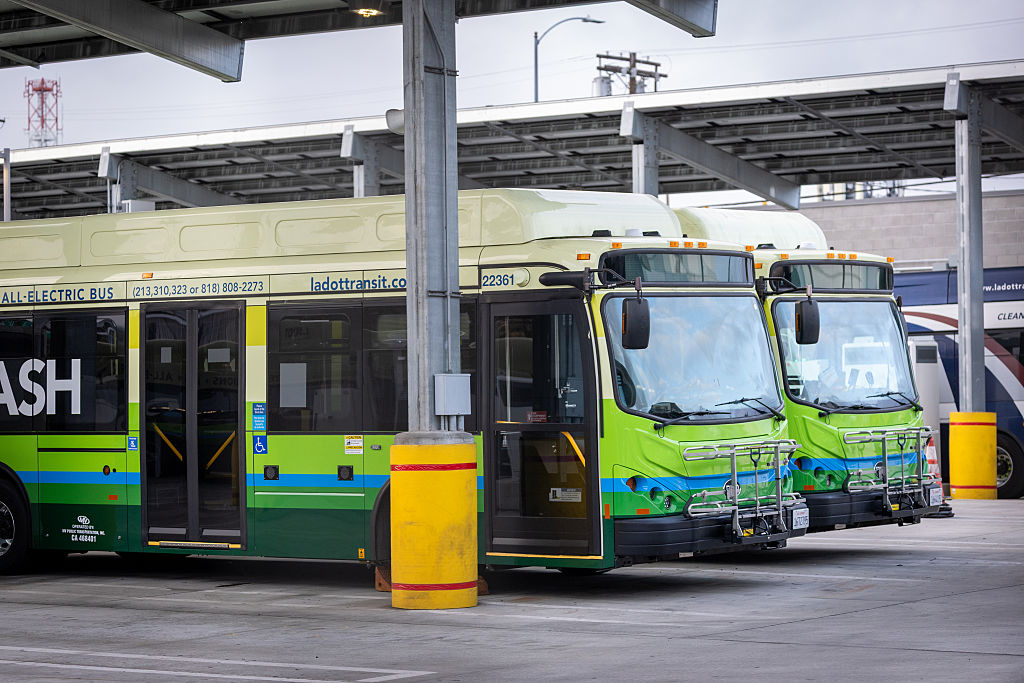
A bill before Congress would close loopholes that allow companies linked to the Chinese government from winning federally assisted contracts.
A few weeks ago a story came and went with relatively little notice: The U.S. military is reportedly barring BYD vehicles from an airbase in Japan.
According to Reuters, citing South Korea’s Yonhap news agency, the concern centers on vehicle cameras and sensors that could collect and leak sensitive security-related information from the base. The restriction reportedly applies to BYD vehicles used by base personnel, contractors, commercial entities and taxis.
If BYD vehicles are considered enough of a security risk to be kept out of a U.S. military installation overseas, why do BYD-linked vehicles continue to have a presence in major U.S. cities, airports, ports and other critical transportation infrastructure here in the United States?
To be clear, the United States has already taken substantial steps to keep Chinese passenger vehicles out of the U.S. market. Chinese electric vehicles face steep tariffs, and the U.S. Commerce Department’s connected-vehicle rule phases in prohibitions on certain connected vehicles, software and hardware with a sufficient nexus to China or Russia. It includes a Model Year 2027 prohibition affecting covered software and certain manufacturers. Commerce explicitly based the rule on national-security concerns involving sensitive data and potential remote access.
But that connected-vehicle rule applies to vehicles under 10,001 pounds and does not apply to vehicles already on the road. That means heavy-duty transit buses, terminal tractors and other vehicles manufactured by Chinese companies currently fall outside the rule’s vehicle-weight scope.
BYD’s own corporate history says it opened a bus manufacturing facility in Lancaster, California, in 2013 and produced its 300th battery-electric bus there in 2019. BYD’s U.S. commercial-vehicle operation now operates under the RIDE name. The company describes itself as the “U.S. spinoff of BYD,” and continues to market electric transit and school buses as well as an 8Y Class 8 battery-electric terminal tractor marketed for ports and warehouses. Before the RIDE spin-off, BYD said its 8Y and 8TT heavy-duty electric trucks were being operated at the Port of Long Beach.
The concerns, however, persist. In June, the U.S. Department of Defense (DOD) added BYD to its Section 1260H list of “Chinese military companies” operating directly or indirectly in the United States. DOD said BYD is directly and indirectly affiliated with China’s State-owned Assets Supervision and Administration Commission, indirectly affiliated with the Ministry of Industry and Information Technology and qualifies as a military-civil fusion contributor. BYD has publicly disputed the designation and subsequently brought litigation.
It’s not just U.S. tariffs that have kept companies such as BYD at arm’s length. The Transportation Infrastructure Vehicle Security Act was enacted in December 2019 and restricts federal transit funding for buses and railcars from certain companies tied to the Chinese government. The Airport Infrastructure Vehicle Security Act, enacted in 2024, extended a similar principle to airport infrastructure programs.
The bipartisan STOP China Act, led in the U.S. House by Reps. Rick Crawford (R-Ark.) and Ro Khanna (D-Cal.) and in the U.S. Senate by Sens. John Cornyn (R-Texas) and Tammy Baldwin (D-Wis.), aims to close remaining loopholes, including those related to corporate restructurings or spin-offs involving otherwise restricted companies. It would prevent U.S. Department of Transportation financial assistance from being used to purchase rolling stock vehicles or powertrain components from companies under China’s influence and require the federal government to identify prohibited entities. The Alliance for American Manufacturing (AAM) has already endorsed the legislation, arguing that Chinese companies shouldn’t be able to circumvent the intent of TIVSA and continue benefiting from U.S. taxpayer-supported transportation spending.
The good news? The STOP China Act has been incorporated into the BUILD America 250 Act – the five-year surface transportation reauthorization bill that advanced out of the Transportation and Infrastructure Committee on a 62-2 vote. The bad news is the path to completing surface transportation reauthorization before the end of the year remains uncertain.
Nevertheless, the STOP China Act is the logical next step to make sure federal transportation dollars aren’t used to support Chinese-linked vehicles through gaps in existing law or changes in corporate structure. AAM hopes Congress passes this important legislation sooner rather than later.