

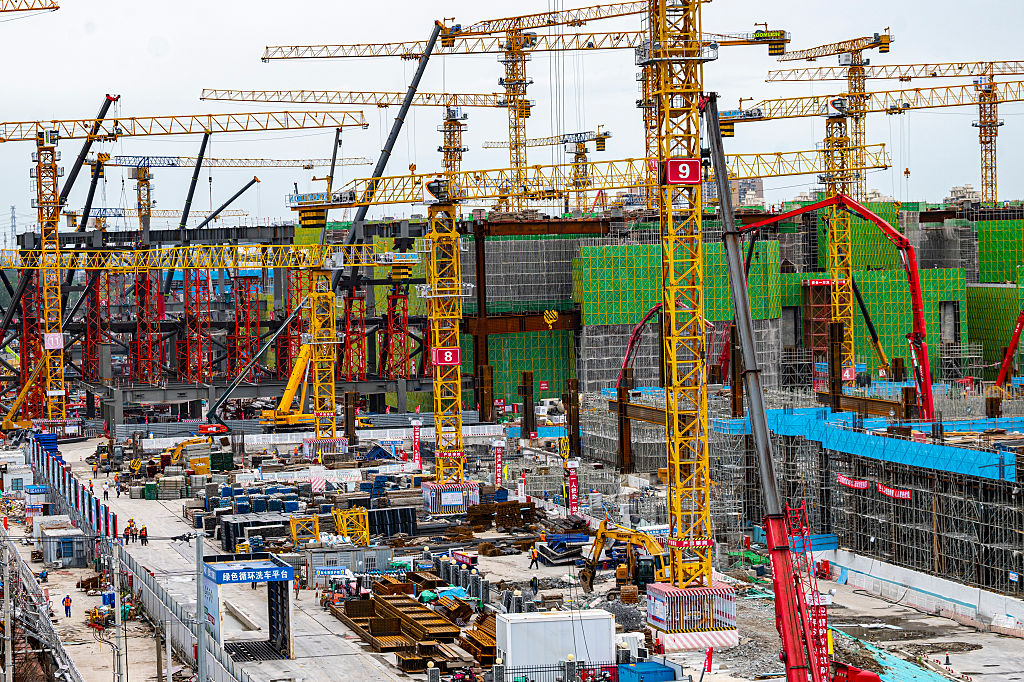
Trillions of dollars on infrastructure spending to boost flagging demand will likely create a production glut that will spill into international markets.
China is preparing another enormous infrastructure boom: roughly $3.7 trillion through 2030 across power, water, computing, communications, logistics and urban infrastructure.
The Economist magazine reported in October that the spending includes about $820 billion on power infrastructure, more than $900 billion on water infrastructure, $600 billion on computing infrastructure and $400 billion on logistics, plus major spending on telecommunications and pipelines.
The Chinese government frames these projects as part of its latest five-year plan and a way to boost weak domestic demand, an underlying condition that helps fuel the country’s surging exports. Outside observers like the International Monetary Fund warn that China’s growth model ultimately needs to become more balanced and supported by household consumption rather than production alone.
Almost $4 trillion in infrastructure spending suggests the Chinese leadership isn’t heeding that advice, and its plans for economic growth could have consequences for industries in the countries China trades with. Infrastructure spending is inherently materials-intensive, and the scale of these investment targets (an estimated 3% of China’s GDP, by the Economist’s estimation) means they will be relevant for steel and other industrial inputs that are traded internationally.
As such, it’s likely that the groundwork for the next Chinese overcapacity problem is being laid right now. Because what happens to the inevitable productive capacity that is built out after this round of Chinese infrastructure-building cycle subsides?
The Alliance for American Manufacturing has long argued that industrial overcapacity is a feature and not a bug of China’s economic system. Yes, state-supported infrastructure projects will temporarily absorb production. History shows, however, that we shouldn’t presume that production will wind down when the projects end, or that the largess of this industrial overcapacity will stay in China.
It won’t always come directly from China either. Surplus production spills over through third-country exports and gets folded into downstream products. It shows up as unfairly traded imports that arrive in foreign markets via transshipment and circumvention, puts companies in market economies out of business and lays off their workers. That’s why incoming Washington lawmakers should take care not to make U.S. trade enforcement slower or more difficult to wield. They should instead be modernizing trade enforcement laws via legislative proposals like Leveling the Playing Field 2.0 Act, the PAIL Act and related reforms. U.S. industry must be able to effectively confront the reality of both today’s overcapacity and the next wave we’re likely watching build up.
Mobilizing around this looming economic threat even presents an opportunity for collaboration between the incoming Democratic Congressional majorities and the Trump administration: The United States, whose manufacturing sector is not in a chronic state of overcapacity, needs its own infrastructure investment.
The American Society of Civil Engineers’ 2025 Report Card gives U.S. infrastructure a C and estimates a coincidental $3.7 trillion investment gap over the next decade, even if recent funding levels continue. What’s more, federally supported infrastructure spending is also subject to robust Buy America laws. Provided those are kept strong, applied without loopholes and fully enforced, an investment in American-made surface transportation projects would improve our own economic efficiency and bolster our own productive industries – all while preempting some of the damage that Chinese overcapacity will cause in their markets. It would be a second term accomplishment for President Trump and create a record of job creation for the next Congress.
At minimum, however, our ability to stymie unfair trade needs to be maintained. The world is already awash in China’s productive overcapacity in many industries, and U.S. trade enforcement tools that can push it back must be kept nimble, sharp and available – especially since we can see the overcapacity problem of future on the horizon.