

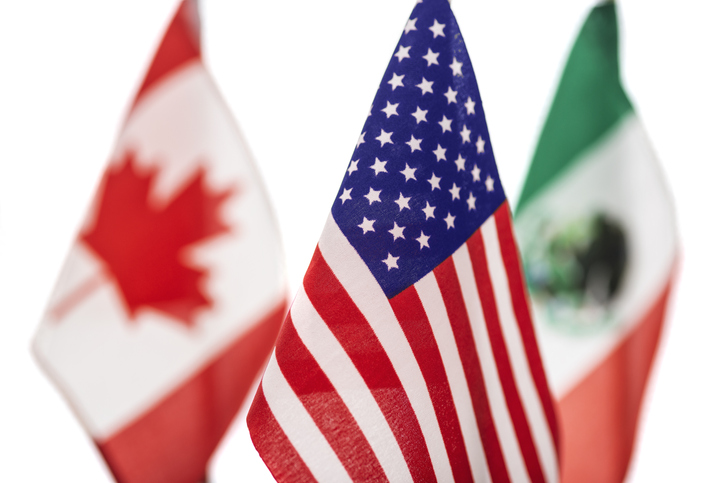
The U.S. has declined the option to continue the trade agreement as-is for another 16 years. Until its loopholes and rules of origin are fixed, that’s a good thing.
July 1, 2026 was a big day in the life of the United States-Canada-Mexico Agreement (USMCA) struck by the three countries in President Donald Trump’s first term. Per its rules, they had to meet six years after it took effect on July 1, 2020 and each had to affirm whether they wanted to extend the deal by 16 years, or move into a phase of annual reviews, with a potential final expiration in 2026.
The result, long telegraphed, is in: The United States has declined the extension, and the agreement will now face annual reviews.
That’s not to say the three could cut another trilateral deal in the future, as many business groups are urging. Before it does, though, they’ve got to do something about the deal’s significant shortfalls.
The Alliance for American Manufacturing (AAM) laid out its concerns last fall in a detailed letter to the U.S. Trade Representative, and recommended that the United States not re-up the deal until they were adequately addressed.
Among those concerns? The USMCA is still encouraging industrial flight from the United States into Mexico:
Mexico has emerged as the primary destination for North American manufacturing investment, attracting more than $36 billion in FDI overall. This larger figure accounts for U.S. corporations reorganizing supply chains under USMCA and comes at the expense of U.S. industrial capacity.11 Although the agreement intends to promote regional integration, its practical effect has been to divert industrial investment and existing capacity away from U.S. communities in a lopsided manner.
Another concern are the foreign direct investment flows that strongly suggest China is using Mexico as a backdoor to sell its products in the U.S. market:
Since 2016, the U.S. trade deficit with Mexico has nearly tripled from $63 billion to more than $171 billion in 2024 while the U.S. trade deficit with China has narrowed during the same2 period.1 This shift does not represent a genuine onshoring of production to North America, but rather a reallocation of U.S. trade deficits from China to Mexico as multinational and Chinese firms reconfigure supply chains to take advantage of USMCA’s preferential access to the U.S. market.
And a third is the lax USMCA rules of origin (ROO) that determine which products get duty-free treatment inside the trade bloc:
Absent a more robust response by Mexico, gaps in the USMCA’s rules of origin will continue to accelerate a structural shift in wealth and production from the United States to China via Mexico. Left unchecked, this trend undermines the agreement’s intent, distorts North American supply chains, displaces U.S. jobs, and erodes the foundation of U.S. manufacturing and national security.
Our position has not changed. In fact, AAM President Scott Paul reiterated it in response to the news that the 16-year extension would not be made. Said Paul:
This review cannot be a rubber stamp. The United States has a critical opportunity to renegotiate the agreement and defend America’s workers. Though China is not a partner in this trade deal, its automakers are working hard to leverage it to infiltrate the U.S. market — a potential and completely unacceptable outcome of a weak USMCA that would wipe out our nation’s auto industry.
You can find Paul’s statement here. And our November 2025 letter on the USMCA’s shortfalls can be found here.