
Allowing exceptions for single companies or loosening the Connected Vehicle Security Act’s standards will ultimately undermine it.
The U.S. Senate has adjourned. It won’t be back until November and after the midterm federal elections have been held.
When they get back, senators are expected to pick up legislation that was nearly fast-tracked through the chamber before they left: The Connected Vehicle Security Act (CVSA). Sponsored by Sens. Elissa Slotkin (D-Mich.) and Bernie Moreno (R-Ohio), the bill would codify an existing U.S. Commerce Department rule that bans the import of Chinese connected vehicle hardware and software.
Effectively, the rule is what’s keeping Chinese automobiles out of the United States. The bill seeks to make that rule permanent.
But there are calls to weaken the bill before bringing it up for another vote. In addition to the hardware and software rules, the CVSA would also restrict companies with more than a 15% ownership by Chinese entities.
That would affect luxury automaker Mercedes-Benz; Chinese entities control nearly 20% of that company. The bill’s Senate critics want that threshold removed – or an exception to be made – before letting it move forward.
That would be a mistake.
There are legitimate national security concerns being addressed by the CVSA that don’t disappear because the company in question is a well-established European automaker: Meaningful Chinese ownership creates potential avenues for Beijing to gain influence or access involving sensitive U.S. vehicle data or deploy malicious hardware and software.
What’s more, the 15% threshold is already a compromise; when a Senate committee debated this bill over the summer, Sen. Moreno said Mercedes would have until 2030 to come into compliance and could also seek a waiver.
Carving out Mercedes, Volvo or any other company that might be affected by the bill – or replacing the bright-line 15% standard with a looser and more subjective test – would create precisely the kind of loophole the CVSA is intended to close.
The correct answer to this problem, therefore, is not for Congress to weaken this bill to accommodate Mercedes. The answer is for Mercedes to reduce that 20% China exposure.
And this is to say nothing of the economic argument for a strong prohibition against Chinese automobiles in the United States.
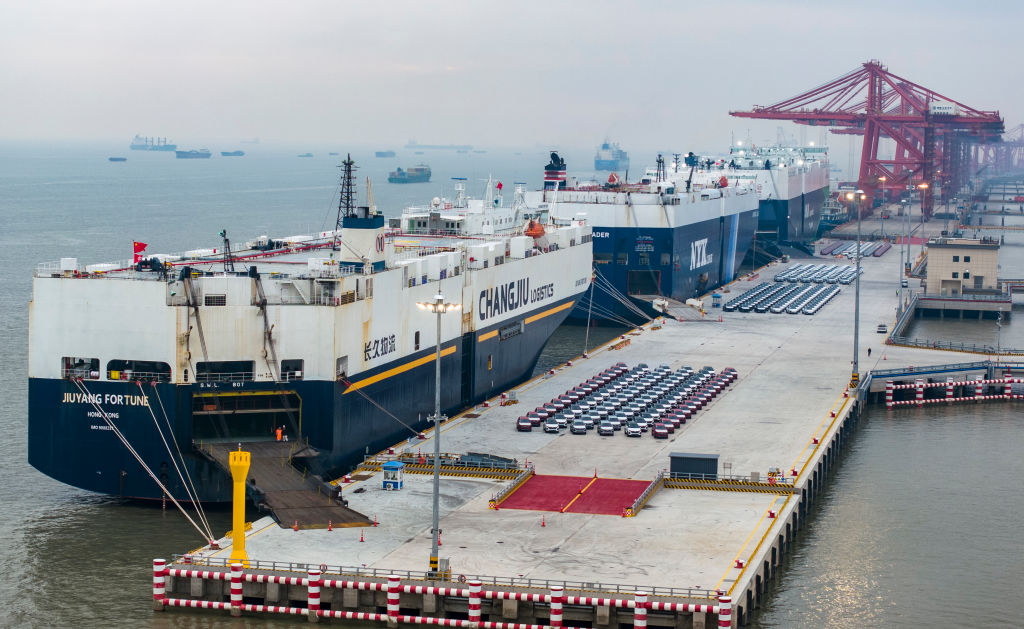
Recall that China’s automakers are currently sweeping across the globe, looking for export markets to dominate. That software rule (and tariffs) is currently keeping American consumers from these ultra-cheap Chinese-made vehicles; it’s also keeping American workers at American auto and auto parts factories from having to compete with them. They shouldn’t have to compete with an export machine backed by the Chinese state. If Chinese automakers are allowed into the U.S. market, they’ll supplant existing supplier networks with their own.
That has been the experience in Thailand, a country that allowed itself to become an export platform for China’s auto industry. From Friday’s New York Times:
Ruth Banomyong, a professor of supply chain management at Thammasat University in Thailand, said there was little evidence that Thailand was benefiting. Chinese automakers, he said, operate within a ‘closed ecosystem’ that makes it difficult for Thai companies to enter their supply chains because the core technology remains in China.
This is a mistake we can see coming, and we shouldn’t make it. Tell Congress to pass the CVSA as is.