

We should be industrializing now, before the next crisis leaves the country even more exposed.
The Wall Street Journal reported last week that Pentagon officials have been meeting with executives of American manufacturing companies about increasing output of military equipment and munitions as the wars in Ukraine and Iran deplete stockpiles. And the talks have been going on for some time. “Lawmakers and the Pentagon have grown especially concerned about U.S. weapons manufacturing capacity,” reads the article, “after Washington and its North Atlantic Treaty Organization allies began transferring large quantities of weapons to Ukraine following Russia’s full-scale invasion in 2022.”
Seems like a prudent thing to do. We shouldn’t forget, however, that supply chain security has been a problem identified long before now.
As the article points out: It was an issue during the early Covid-19 pandemic, when hospitals were overflowing with patients suffering from serious respiratory issues and the first Trump administration had to recruit automakers to work with medical device manufacturers to make ventilators.
And years earlier reports were identifying chokepoints in supply chains where deindustrialization had increased the U.S. military’s vulnerabilities. The Alliance for American Manufacturing’s (AAM) own, commissioned in 2013, raised this exact warning:
“The supply chains that link our defense industrial base to our armed forces are vulnerable to disruption. Many of the tools we need to mitigate that vulnerability are at hand, but must be strengthened in light of the global forces that affect our entire economy, including our vital defense industrial base. The most urgent task is to galvanize our government and industry to act to address the problem.”
In the 13 years since then the country has been fortunate not to have been involved directly in a major military conflict, but the bill of deindustrialization – when it comes to military preparedness, in this instance – appears to be coming due and to no one’s surprise.
Here’s what AAM President Scott Paul wrote in a 2020 New York Times opinion, in response to administration’s selective use of the federal Defense Production Act to induce private-sector companies into the domestic manufacture of medical equipment:
“That may be a successful short-term bludgeon, but expanding the act’s use to organize a national manufacturing strategy to meet this moment would be much better than the current piecemeal approach to producing the millions of items health care workers need to handle a surge of sick Americans.”
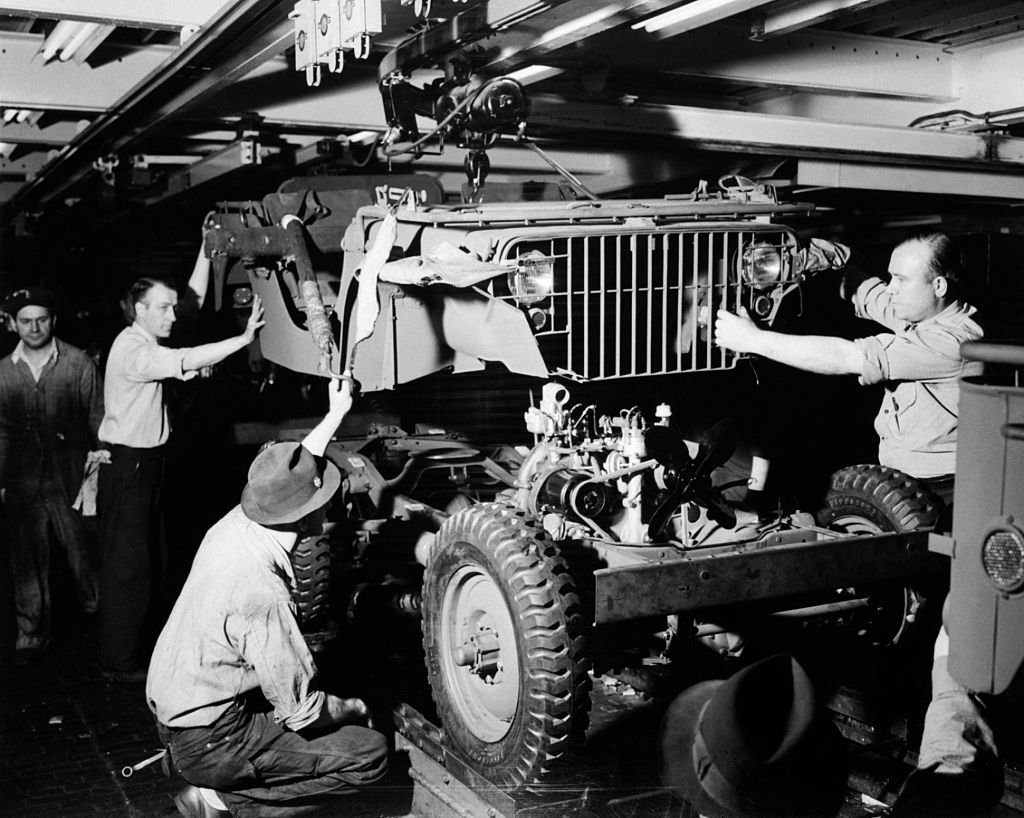
Nothing about that kind of massive reindustrialization would be easy. When many American factories of the 1940s converted entirely to military production – places like River Rouge and Willow Run in Michigan that made jeeps and bombers and Sparrows Point in Maryland that built cargo ships – were collocated in deep industrial ecosystems and supply chains that made their ability to take on military production all the easier. Modern industrial supply chains are far-flung. Gathering them back is not done overnight.
Public policy should be focused on doing it anyway before the next crisis arises. National security and industrial capacity are intrinsically linked. We should keep that in mind when we geopolitical rivals seek to enter important U.S. industrial sectors via arrangements like, for instance, joint venture battery and auto assembly plants.