

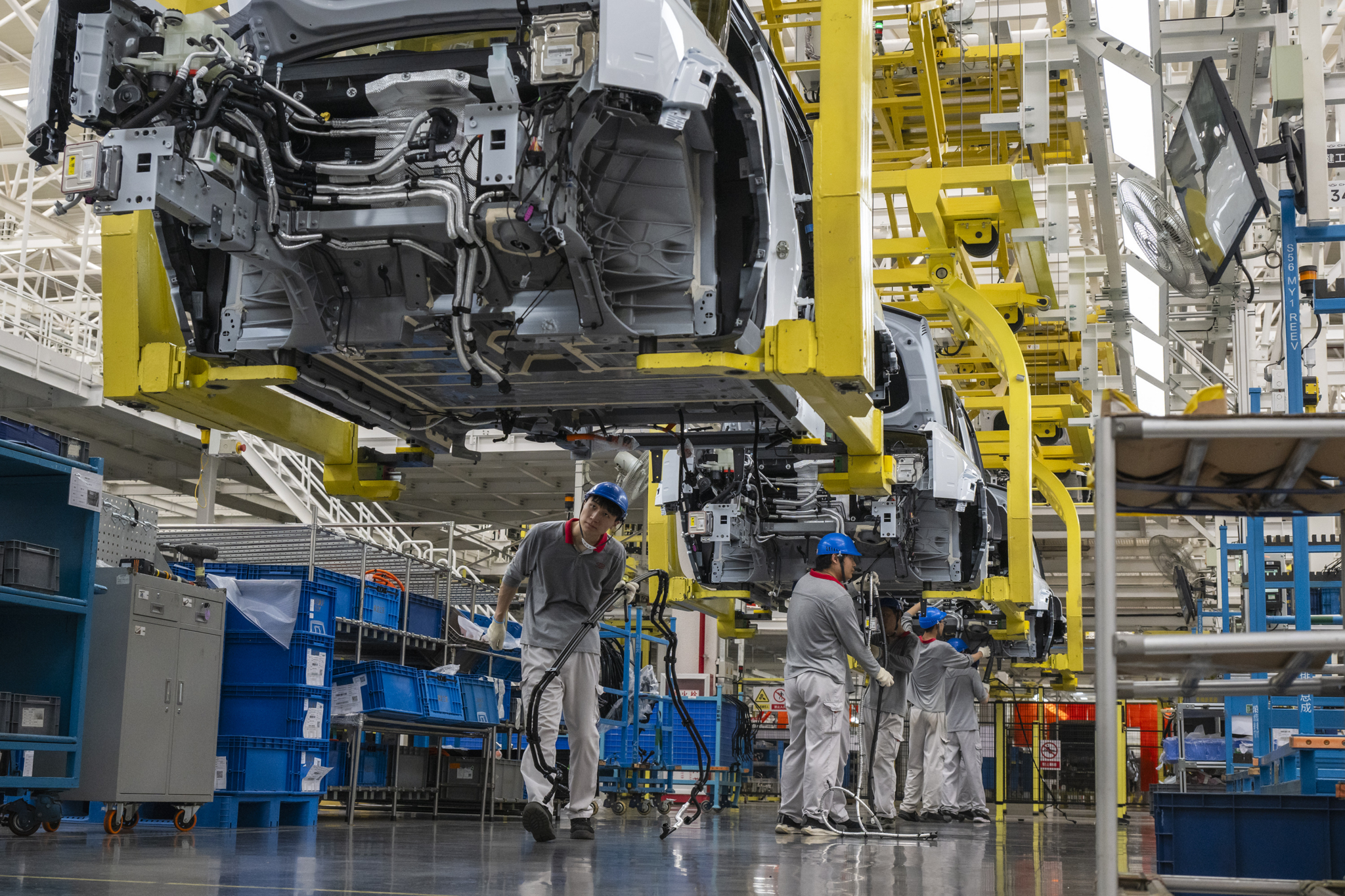
A look at two of the sectors being examined by the USTR Section 301 overcapacity investigation.
The Office of the United States Trade Representative (USTR) has launched a major investigation into structural excess capacity, examining how foreign government policies are driving production far beyond market demand and distorting global trade. In response, the Alliance for American Manufacturing (AAM) is taking a closer look at how overcapacity undercuts American workers, weakens domestic manufacturing and discourages long-term investment in industries flagged in the USTR probe.
Autos and glass are both on the list, and both show the same warning signs: production capacity racing ahead of demand and surplus output pushed into global markets.
Start with autos. A common benchmark is that a “healthy” manufacturing sector runs around 80% utilization. U.S. Federal Reserve data show the U.S. auto industry’s utilization has been below that threshold for roughly a decade. But the worldwide system keeps expanding. Global motor vehicle production expanded from roughly 78 million units in 2020 to 93 million units in 2024, spanning passenger cars, commercial vehicles, buses and coaches.
While not the only culprit, a ton of expansion comes from China. Decades of state planning and subsidies have resulted in an industry capable of making 55.5 million vehicles annually by 2024, but more than half of that capacity sat idle, according to Shanghai-based Gasgoo Automotive Research Institute. When utilization collapses to that level, producers have powerful incentives to find workarounds to keep plants running. So they cut prices and chase exports. And exports are indeed way up.
But that overcapacity travels, too. Chinese automakers are increasingly using third-country production platforms to externalize surplus capacity and preserve market access. Auto giant BYD has opened its first passenger vehicle plant in Thailand with capacity of roughly 150,000 vehicles per year, described by Thai officials as a regional export hub. That same company is building its first European production base in Hungary and exploring potential manufacturing in Mexico and Canada, including repurposing existing assembly facilities.
BYD is also constructing its largest manufacturing facility outside China in Brazil, a market in which it has a strong and growing presence. According to Bloomberg, Brazilian authorities found workers building the factory under conditions they described as “analogous to slavery,” and added the company to an official registry, though Reuters has subsequently reported that the decision is now entangled in a political and legal controversy after a senior inspector was dismissed for defying pressure related to the listing and a Brazilian court has intervened.
It’s not all China, though. Outside of that country, vehicle assembly capacity is estimated at more than 110 million vehicles annually versus roughly 89–90 million vehicles in global production — implying excess capacity of more than 20 million vehicles per year. Overcapacity that began during the Covid-19 pandemic is projected to become a persistent challenge, resulting in an excess of more than 100 million units between 2020 and 2030. This squeeze, according to researchers, “trickles down the value chain,” with the expected impact most pronounced in Europe and North America.
The glass sector tells a similar story: Demand is not growing fast enough to justify the pace of capacity expansion. The Freedonia Group puts global flat glass demand growth at approximately 2–3% annually, while capacity — especially in China, where it has been an issue for decades — has expanded much faster. The result is persistent imbalance, downward price pressure and export competition that can overwhelm market-based producers.
Recent data points highlight the scale. Intel Market Research reports that China’s float glass capacity exceeds 1 billion square meters annually and has grown by more than 20% in recent years, intensifying price competition and contributing to global overcapacity. Oversupply is also visible in photovoltaic glass: SunSirs Commodity Data finds utilization rates in that segment have fallen to approximately 66%. Weak downstream demand in China’s real estate sector has compounded the problem, pushing producers to compete more aggressively in export markets.
Glass is not just a market story; it’s a policy story. A 2009 AAM-produced report on China’s glass sector that found it received at least $30 billion in Chinese government subsidies in the 2000s. That kind of support fueled capacity growth and export surges that competitors could not match under normal conditions. As Chinese production and exports surged, U.S. glass imports from China more than tripled and domestic employment fell sharply. Even high-profile projects were not immune: Chinese-made glass being selected for parts of the World Trade Center reconstruction, despite U.S. manufacturers having the technical capacity to supply it.
The employment numbers show what overcapacity can do over time. Since China entered the WTO in 2001, U.S. glass manufacturing employment has fallen from roughly 140,000 workers to about 75,000, nearly a 50% decline. A single Chinese glass manufacturer, which in 2016 began operating in a shuttered GM plant near Dayton, Ohio, now controls a significant share of the U.S. automotive glass market — roughly 30% by one estimate.
Autos are bigger and more complex than glass, but the mechanics rhyme: Utilization below healthy levels, capacity expansions outpacing demand and surplus production redirected outward through exports or offshore platforms.
This is why USTR’s investigation matters. Overcapacity is not a temporary imbalance. It’s a structural problem that can hollow out domestic industries long before demand ever returns.
The Alliance for American Manufacturing is looking at how sectors mentioned in the U.S. Trade Representative’s Section 301 investigation into global industrial overcapacity are affected by this market condition. You can read our introduction to this series here and our look at overcapacity in the steel sector here.