

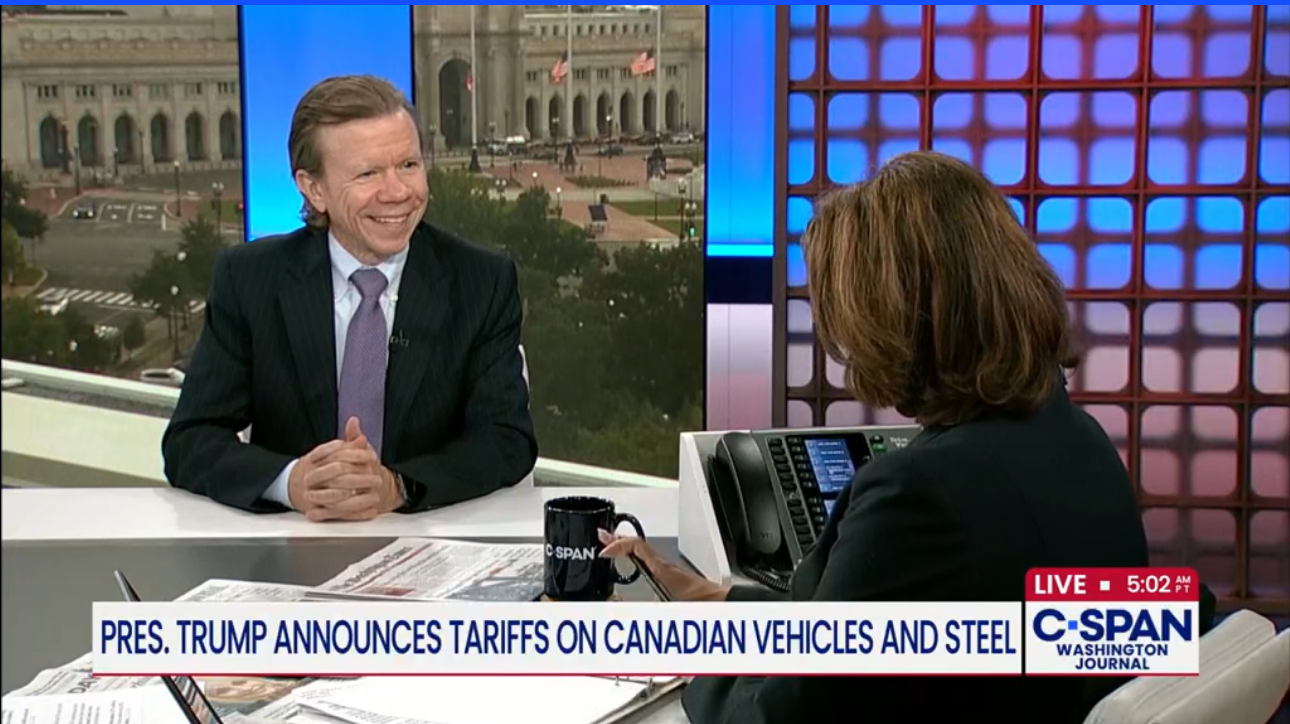
AAM’s Scott Paul gets into detail live on C-SPAN.
Unless you’ve been living under a rock, you’ve likely noticed that tariffs – a certain president’s favorite word – have been in the news a lot recently. And tariffs can have a significant effect on U.S. manufacturing activity. So, how to analyze manufacturing’s outlook? Alliance for American Manufacturing (AAM) President Scott Paul was on C-SPAN’s Washington Journal program last week, where he tackled that question and others.
You can watch the entire segment here. Or see a couple of clips from the appearance below:
How are America’s factories faring in 2026?
Paul wrote about this recently on AAM’s blog.
“There was a period where manufacturing was having some challenges. I think we’re out of that now,” he said. “You’re seeing some of the results of the factory construction boom. Some of this goes back to the Biden administration, there’s evidence of a lot of factory construction that started in 2022 and 23 with respect to semiconductors, pharmaceuticals, some other goods like that, and has been continuing, although at a slightly lower rate, and now people are coming to fill jobs in those factories.”
AI is Bringing a New Generation of Workers to U.S. Factories
“Young people for a whole generation have been conditioned not to look at manufacturing for a career and there’s strong evidence that is changing, particularly as AI hits those entry-level positions that are white collar and all of a sudden the idea of putting on a tool belt or going to trade school and potentially making 80 or 100,000 dollars as an electrician at a factory looks a lot more appealing,” Paul said.
Manufacturing is a ladder to the Middle class
“I think there has been an imbalance between labor and capital that’s been well documented, that has expanded over the last couple of decades,” Paul said. “I do think manufacturing is an industry where you can still find good wages in the United States and particularly for the majority of Americans who won’t have a four-year degree. It’s a ladder to the middle class.”
China’s currency is crushing U.S. manufacturing
“There have been active efforts over the decades to keep the value of the Chinese currency low in order for them to gain a trade advantage. It makes their goods cheaper to send overseas. I wish the Trump administration did more on currency, particularly with respect to China,” Paul said. “I think that’s necessary to have a better relationship moving forward. Hopefully Trump will raise that with [Chinese leader Xi Jinping] when they meet in September.”
Are Chinese autos coming to the United States?
“What the Carney government in Canada has done, I think, is defeating for the Canadian auto industry, and that is to turn to China and to say to some of the Chinese auto companies, ‘come in. We’re going to allow you to import some cars into our market. You can enter into joint ventures with some of our companies,'” Paul said. “And what we’ve seen happen in other places around the world that have tried to accommodate that is that it has completely wiped out the auto industries and the Chinese companies are taking over. That’s happening in real time right now in Europe. It’s happened in the UK. It happened in Australia.”
U.S. national security depends on strategic tariffs
“[National security] is the basis for the tariffs that have been in place since 2018 on steel and aluminum. That was under section 232,” Paul said. “And those have been durable. Biden kept those tariffs on. And when you hear Members of Congress raise concerns about tariffs its generally not those steel and aluminum tariffs, it’s some of the other trade actions the administration has taken. That’s not universally true but I think generally true. I completely agree we have to have a baseline productive capacity for critical metals like steel and aluminum that go into defense purposes.”
You can find the entire C-SPAN segment here.