

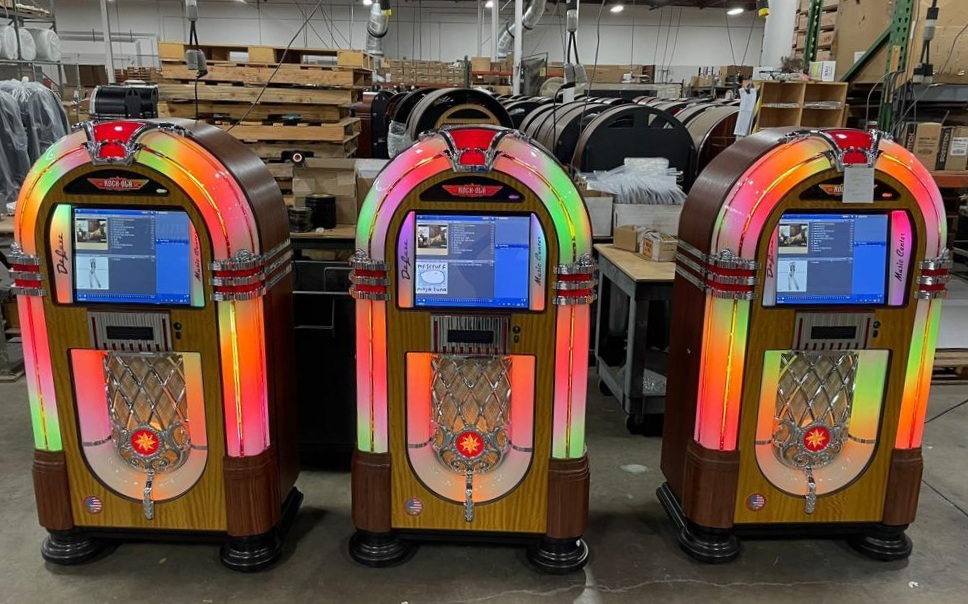
Rock-ola, 99 years old in 2026, builds the intricate machines in its southern California factory.
Just one year shy of its centennial anniversary, the Rock-Ola Jukebox Company is still manufacturing the colorful machines that play hit songs in diners and bars across the United States.
The company was founded by David C. Rockola in Chicago in 1927 as a builder of gumball machines, pinball machines and penny-weight scales. In 1935, Rockola decided to start manufacturing the increasingly popular jukeboxes which brought people’s favorite modern music to them with a drop of a coin when out on the town.
By the end of 1936, Rockola opened a gigantic, 600,000 square foot factory on the north side of Chicago that was the largest facility in the world devoted to coin-operated equipment. The manufacturing campus consisted of 23 buildings, many of which were six stories high.
Rockola named his young business after himself, a name that would in later years reflect the style of records his machines played (rock ‘n’ roll) as well as becoming a synonym for jukeboxes themselves (in Mexico a jukebox is called a rockola).
Chief Operating Officer Ken Urban has been building jukeboxes at Rock-Ola for 54 years of the company’s 99-year existence. His expertise in old-time record playing mechanisms is one of the reasons Rock-Ola has begun to grow again after years of up-and-down sales.
Urban witnessed the end of the reign of the “big four” American jukebox manufacturers in the 1980s when Wurlitzer, Seeburg and Rowe/AMI left the business, but the legend continues at Rock-Ola, the lone American-made survivor.
“I worked 20 years in Chicago for the Rockola family, 27 years for Glenn Streeter who bought it from the Rockola family and moved it to California,” said Urban. “I’ve been with Alexander Walder-Smith, the new owner, for almost eight years now.
“When Rockola started the coin-op business, he put the hyphen in there. He said he wanted people to pronounce it rock and ola with a space between the words.”
Many sources credit Cleveland disc jockey Alan Freed with coining the phrase “rock ‘n’ roll” in the 1950s, despite the term’s use in recordings as early as 1940.
“Alan Freed was one of the guys using that because of his knowledge of Rock-Ola,” said Urban. “On Freed’s tombstone, one side is our bubble machine jukebox and the other side tells the story of Alan Freed.”
Rock ‘n’ roll was certainly a product of the musicians themselves, and jukeboxes were often created by companies that manufactured the instruments used by the music composers.
“Jukeboxes got started by companies that were musical instrument companies,” said Urban. “AMI was American Musical Instruments out of Grand Rapids, Michigan. Wurlitzer, of course, made pianos and organs out of New York City. Wurlitzer was bought out and moved to Germany, and the late ’60s and early ’70s was one of the high points for Rock-Ola. Seeburg was another company that was in Chicago but they went out of business and AMI was not doing much business at that time after moving to Mexico.
“When I started in 1972, we were making a hundred jukeboxes a day. About 50% of those were shipped overseas to a big distributor of ours in Germany. So, we had the handle on all the jukeboxes at the time.”
Today most of the jukeboxes that Rock-Ola sells are for home use. After the housing crisis of 2008, the commercial jukebox business declined because people were not going out to bars and restaurants as much, so Rock-Ola stopped making commercial boxes.
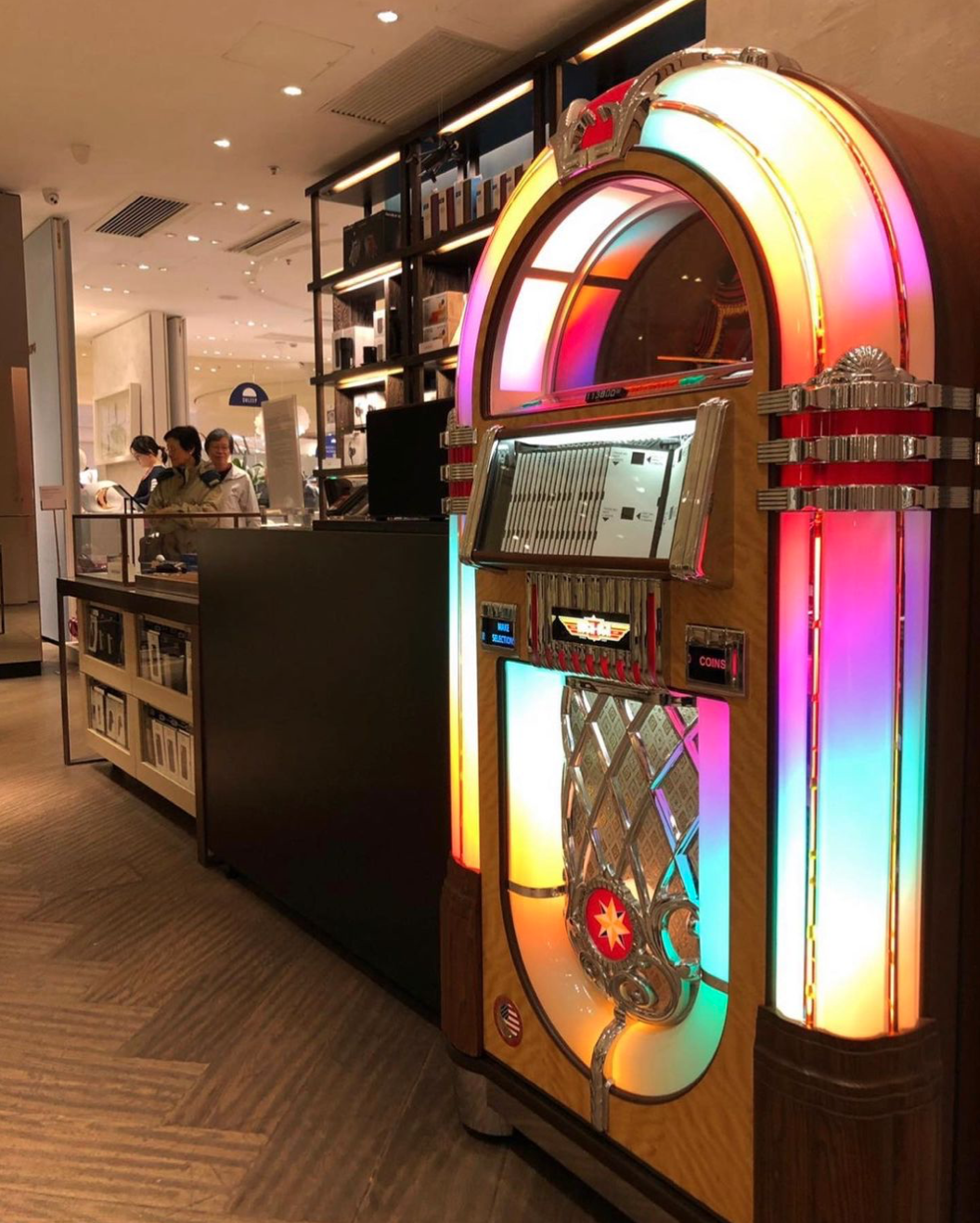
The jukeboxes manufactured by Rock-Ola today are known as nostalgic boxes that encompass old time designs, many of which are based on the Wurlitzer bubbler boxes.
“We still make jukeboxes for locations, but they are all nostalgic boxes,” said Urban. “Rock-Ola boxes today are basically based on old Wurlitzers. We are the only ones making jukeboxes in the United States.
“We sell them mostly for home use but we do sell to Black Bear Diners, which is a chain of restaurants. Also, Texas Roadhouse. We did Johnny Rockets for a number of years and also did counter boxes that sit on the counter where you can make a selection from your booth. Mel’s Diner is another one. They use our juke box and our wallettes, which are the boxes at tables.”
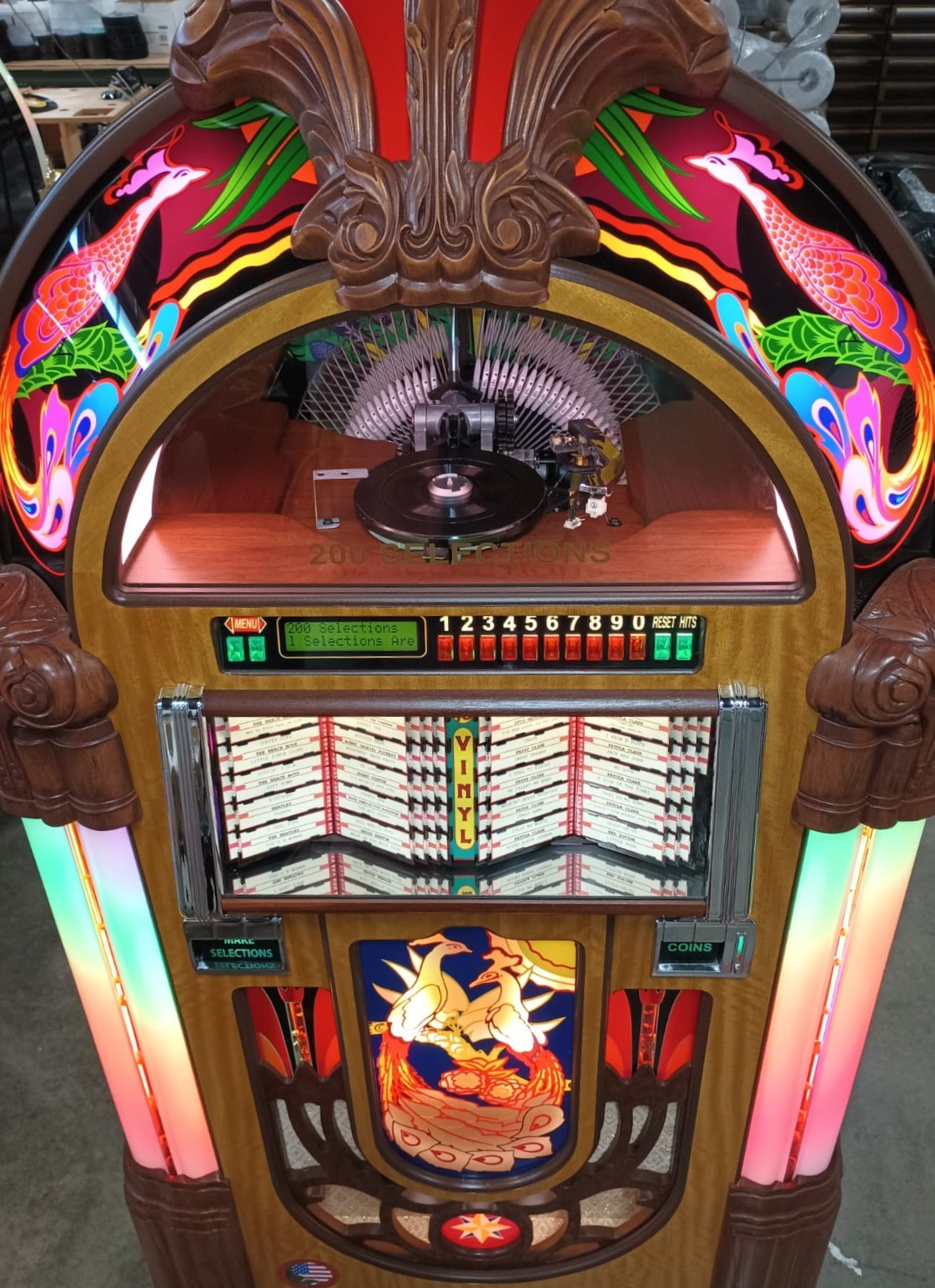
There are many intricate steps in making a jukebox that plays 45 rpm records, a process that Rock-Ola still undertakes today at its large Torrance, Calif. factory. The company also manufactures jukeboxes that play CDs and some that are internet-based.
But Urban takes pride in the old-style vinyl record machines that have become increasingly popular as vinyl record sales have soared. In 2025, vinyl record sales grew for the 19th consecutive year, with 46.8 million units sold compared to 29.5 million CDs purchased.
“Right now, we are trying to build it back up again and we are hiring,” said Urban. “We have about 35 employees and I am looking for more people. You can’t just go out on the street and find somebody that builds jukeboxes. It takes a while to train these people.”
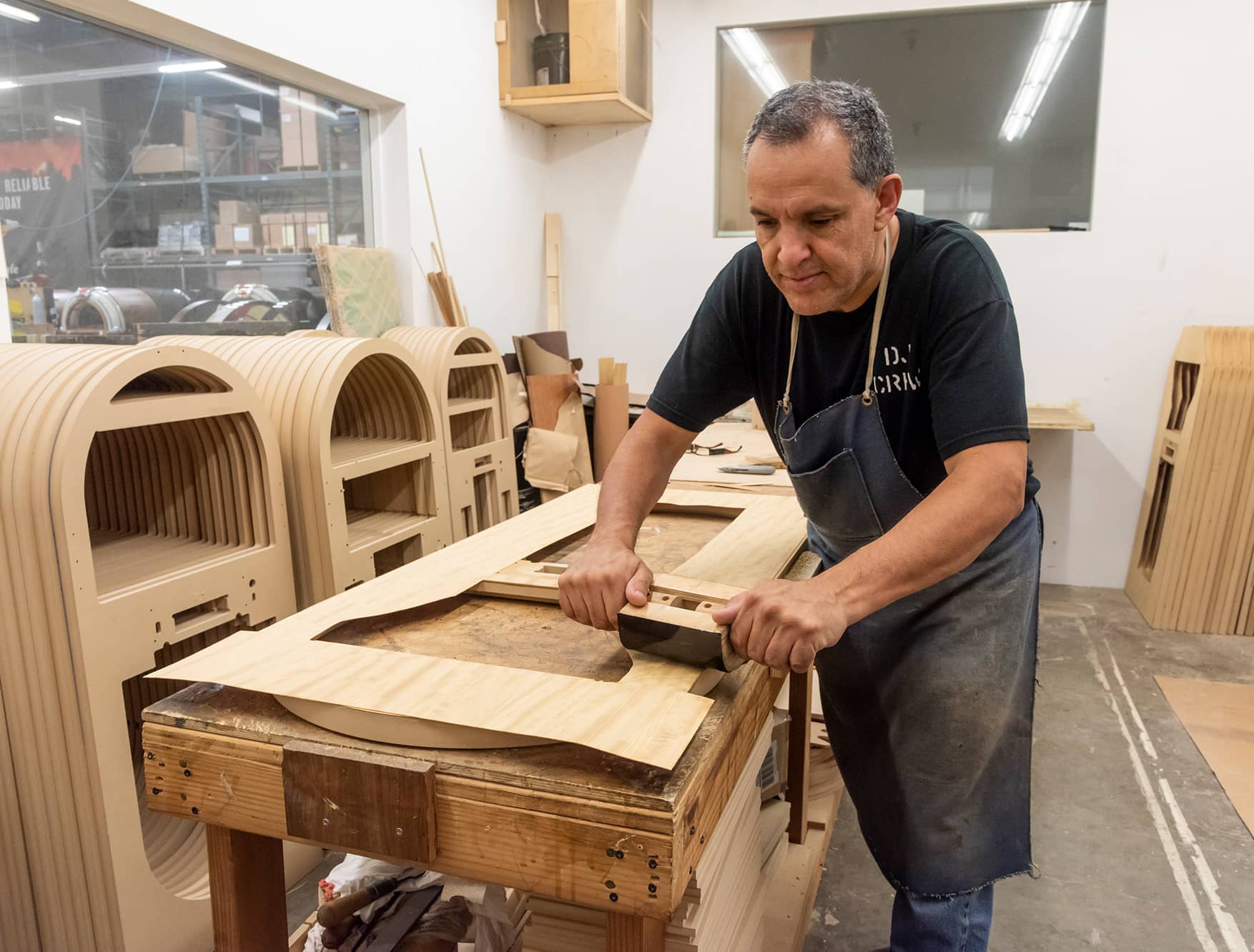
At Rock-Ola, the manufacturing starts with a wooden cabinet. Then the Rock-Ola team forms and paints the plastics on the machine. The bubble tubes – cylinders that create a look of bubbles running through – are also manufactured in house.
“Everything is made here. We don’t job out a lot,” said Urban. “We screen all those color cylinders ourselves. We do all the cabling in house. One cabinet and the door that goes on the door frame before we put the plastics on, we use triple-plated chrome castings on there.
“We’ve got 101 different pieces of wood that go into the door and cabinet. There are a lot of pieces of wood to put that together, the frames. Before we got CNC machines, which streamlined it quite a bit, it was almost 40 working hours to build one door and one cabinet using 10 routers. With the CNC machines we can cut multiple pieces at one time.
“We cut the time almost in half, from 40 hours down to about 23 hours. Everything is still put together by hand. The cabinet presses we have are the cabinet presses we used back in Chicago in the 1940s.”
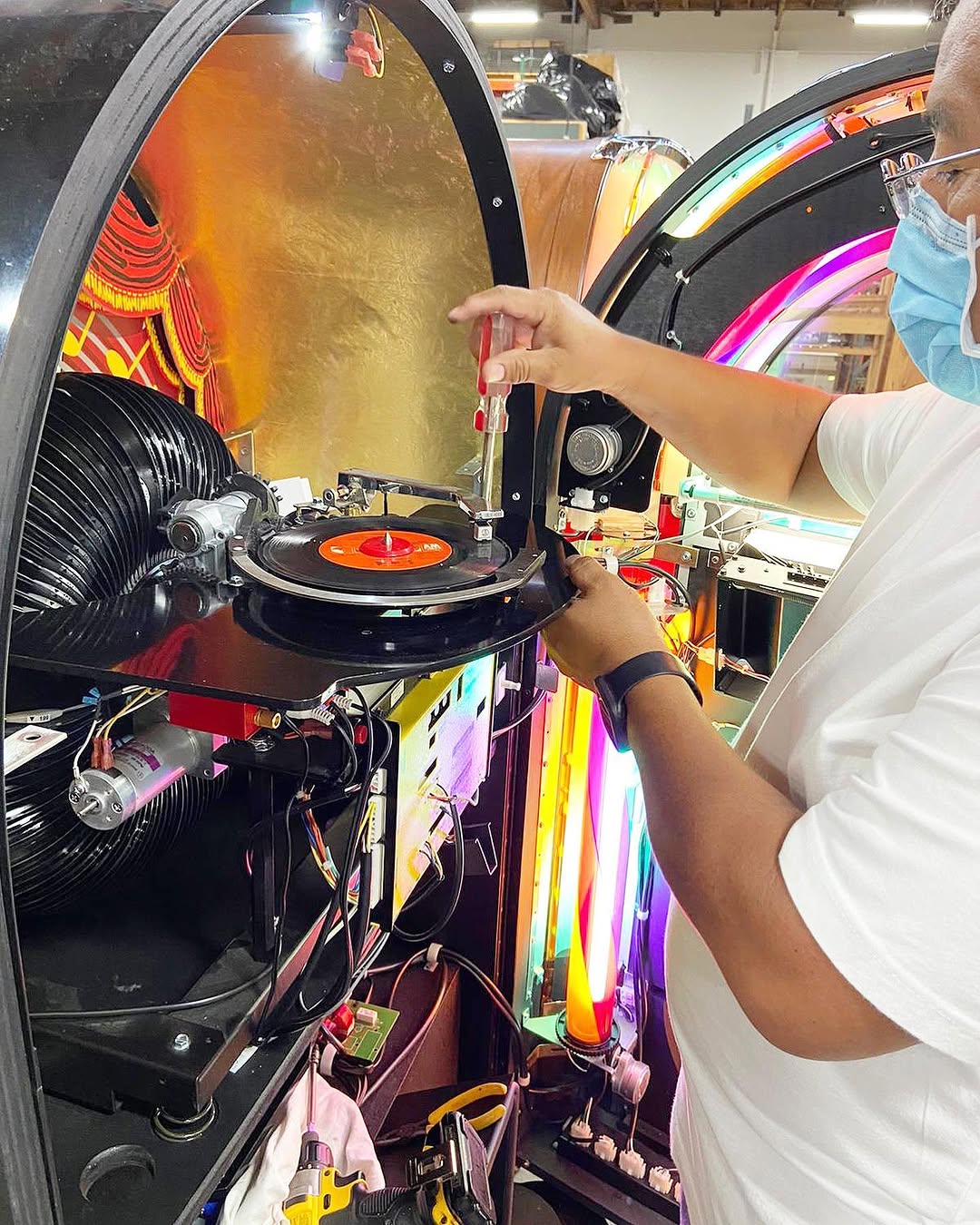
After spending most of his career building prototypes at Rock-Ola, Urban is especially fond of the turntable mechanism on the old-style machines. In addition to building new machines, Rock-Ola has increased its refurbishing business.
“We’re doing jukeboxes we sold 20-some years ago that got passed down from generation to the youngest generation,” said Urban. “Sometimes they say they want it refinished and they haven’t played it for four or five years. You can’t do that. It’s like an old car that doesn’t want to run for you.
“I always tell people, the one thing you should do with a jukebox is play it all the time. At least once a day and it will keep going for you. If it sits, everything kind of freezes up on it, everything gets dirty and the contacts won’t work anymore.”
There are many memorable moments in the nearly 100-year history of Rock-Ola, from the limited-edition Elvis Presley jukeboxes (100 in high-gloss white, 100 in high-gloss black) that are highly collectible, to the Beatles Yellow Submarine jukebox.
“Those jukeboxes were all numbered and became collector pieces,” said Urban. “We built a Yellow Submarine box one time and we built 100 of those and Ringo Starr bought three of them.”
Almost any Rock-Ola jukebox is coveted by collectors, but the machine that drew the most attention was one sold to late Queen frontman Freddie Mercury.
“Glenn Streeter, who brought the company from Chicago to California, sold two jukeboxes to Freddie Mercury and guitarist Brian May of Queen,” added Urban. “The box he sold to Freddie Mercury was an original restored Wurlitzer which he sold for about $6,500 back in the ’80s. Mercury put the jukebox in his kitchen because he said that is where spent all of his time.
“About five three years ago, that jukebox sold for a little more than half a million dollars.”
Now that’s a real jukebox hero.
The Alliance for American Manufacturing does not receive a commission from purchases made through the above links, nor was the organization or author paid for favorable coverage.
Labeling Note: This story is intended to highlight companies that support American jobs and that make great products in the United States. We rely on the companies listed to provide accurate information regarding their domestic operations and their products. Each company featured is individually responsible for labeling and advertising their products according to applicable standards, such as the Federal Trade Commission’s “Made in USA” standard or California’s “Made in USA” labeling law. We do not review individual products for compliance or claim that because a company is listed in the guide that their products comply with specific labeling or advertising standards. Our focus is on supporting companies that create American jobs.
For more on the Federal Trade Commission’s standards for “Made in USA” claims and California’s “Made in USA” labeling law, please also read this guest post by Dustin Painter and Kristi Wolff of Kelly Drye & Warren, LLP.