
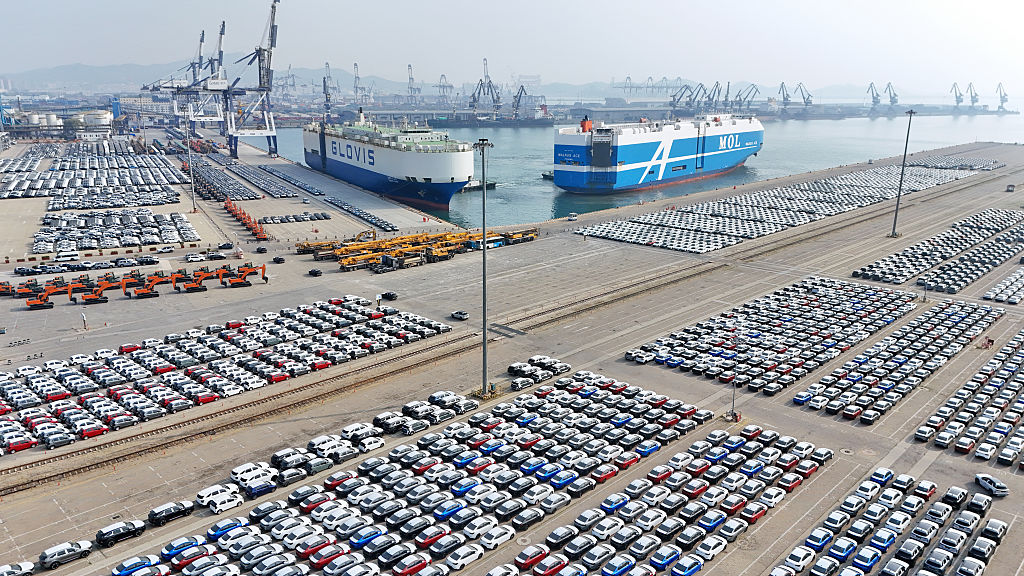
The threat to domestic manufacturers and workers is immense, AAM argues in a new video.
President Donald Trump is scheduled next week to visit China – the first trip there by an American president since the last time he went in 2017 – for a meeting with Chinese President Xi Jinping. Before he leaves, the Alliance for American Manufacturing (AAM) is urging the Trump administration and Congress to make sure the U.S. auto market is not on the table during any potential trade negotiations.
In a video released this week, AAM President Scott Paul lays out the threat to the domestic auto industry that competition from heavily subsidized Chinese automobiles represents. “Beijing engineered its auto dominance on a foundation of state cash and strategic overcapacity,” Paul says. “Now, it’s taking aim at the U.S. market. We’re asking every American who cares about their job, their privacy, their community, and their nation to make their voice heard in Washington before it’s too late.”
Paul points to three big reasons surging Chinese automakers should be denied entry to the U.S. The first is its auto sector’s well-documented overcapacity – factories running on overtime despite weak internal demand – that effectively allows China to export its unemployment problems. The second are the national security concerns inherent in letting Chinese-made connected vehicles – loaded with software, microphones and cameras – roam the United States. And the third is the potential for a China Shock 2.0; the economic and political destabilization we risk by exposing the domestic auto industry and its extensive supply chains to import competition from vertically integrated Chinese rivals.
AAM has long defended American workers from China’s attempts to seize control of the U.S. auto market. In February 2024, we identified Chinese vehicle imports as an “existential threat to America’s auto industry” in a report that called for exclusionary tariffs on all Chinese vehicles. Nine days later, the U.S. Department of Commerce initiated an investigation into national security risks posed by connected vehicles, and in 2025 it finalized a prohibition on the import of Chinese and Russian connected vehicle software and hardware.
AAM’s advocacy also helped pass the bipartisan Transit Infrastructure Vehicle Security Act in 2019, which prohibits federal taxpayer funds from being used to purchase railcars, electric buses and other forms of “rolling stock” from China’s state-owned and -supported vehicle manufacturers. It prompted a meritless libel lawsuit from Chinese automaker BYD that was rejected in U.S. District Court three times, then dismissed in turn by the U.S. Court of Appeals for the District of Columbia and the U.S. Supreme Court.
But we are hardly the only ones concerned about a wave of Chinese cars displacing millions of American jobs in auto and auto parts manufacturing. We are signatories along with like-minded organizations and unions to a recent letter that implores Trump administration officials to keep the U.S. auto market walled off from Chinese vehicles, whether they’re imported or assembled in the United States. And over the past month, lawmakers from both sides of the aisle in the U.S. House and Senate have called on the administration to do the same.
What’s more, legislation has been introduced in the Senate that would codify that Commerce Department ban. The Connected Vehicle Security Act, cosponsored by Sens. Bernie Moreno (R-Ohio) and Elissa Slotkin (D-Mich.), would fully ban from the U.S. market autos, parts and vehicle software made in China or in partnership with China.
It has our endorsement and it should have yours, too. Click here to email your legislator with this important message: Keep Chinese autos out of America by supporting the Connected Vehicle Security Act.