

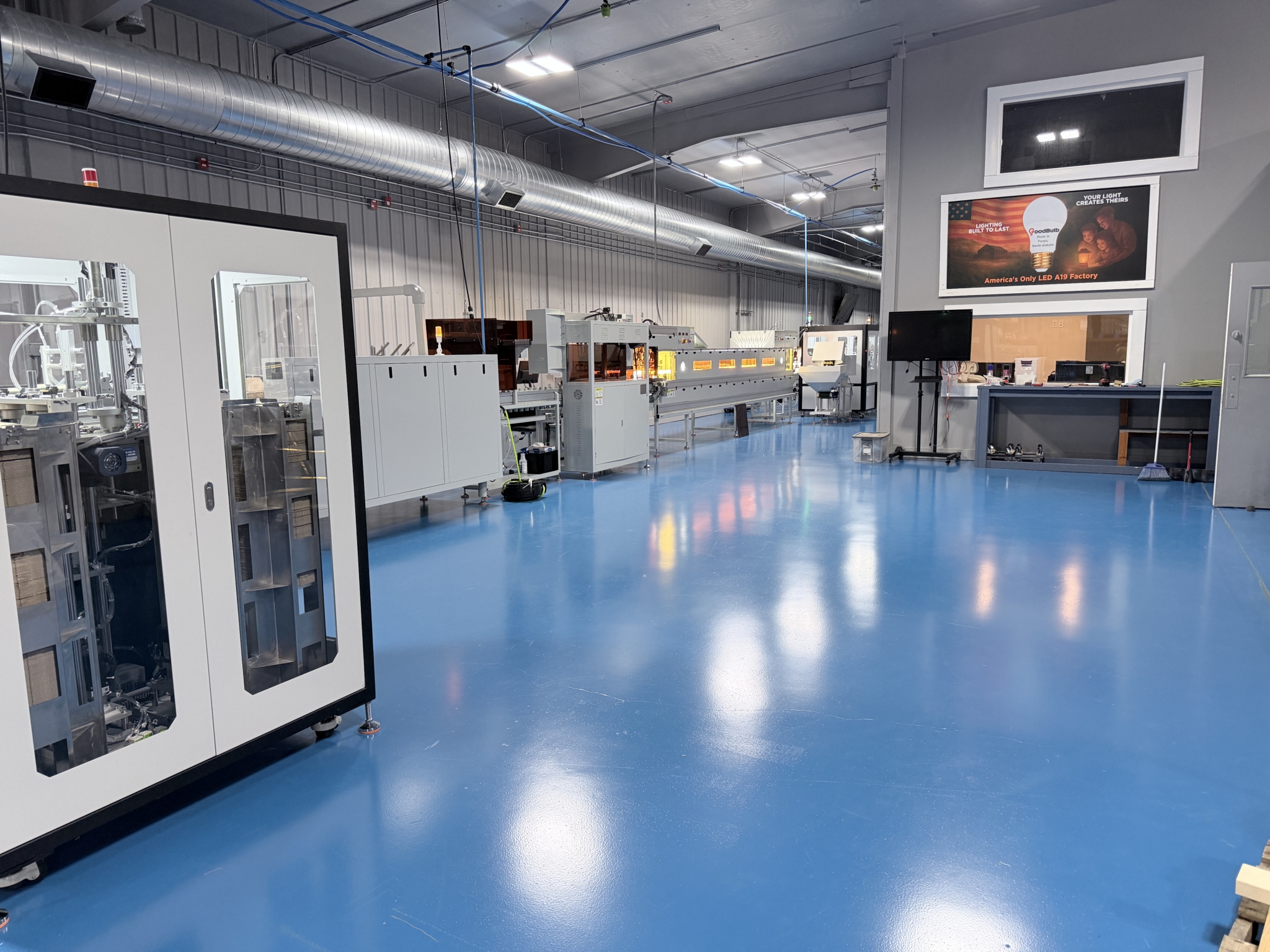
Lightbulb manufacturing had gone entirely offshore. One factory in North Dakota is showing how it can be done in America again.
Tom Enright has been selling lightbulbs for the past 25 years. First as a Chicago door-to-door salesman and today as the only manufacturer of standard LED A19 bulbs in the United States.
The 49-year-old founder of GoodBulb has spent the last eight years developing his lightbulb company in Fargo, North Dakota. GoodBulb can manufacture LED (light emitting diode) lightbulbs at scale in America the way they once were before the major players shipped production overseas to China and Vietnam.
American giants like GE and Sylvania pulled the plug on manufacturing of the standard household lightbulb many years ago. They tried to bring production back to the States when LED lighting manufacturing ramped up at the turn of the 21st century, but couldn’t compete with Asian imports.
Yet Enright was persistent, believing with proper automation America could become competitive again in the LED lighting marketplace. Along the way, he renovated an aging warehouse, designed custom automation machinery and navigated financing hurdles while watching billion-dollar competitors abandon similar efforts.
“We had to go through a lot of obstacles to make this happen,” Enright said. “Yes, I am definitely pro-American manufacturing.”
For Enright, the journey began long before GoodBulb. Born on Chicago’s South Side and raised largely in the suburb of Arlington Heights, he earned a degree in special education with plans to become a teacher. Instead, an unexpected sales job changed his trajectory.
“I fell into a sales job where I made like $20,000 in three months,” he said. “I was 21 or 22 years old. So, I collected those paychecks, quit the job, went to Australia and spent all of my money.”
When he returned, he interviewed for five different sales positions. During dinner with his girlfriend, he asked which one he should accept.
“She said they were all really good jobs,” Enright said. “‘But don’t sell lightbulbs.’ So, the very next day I called the lightbulb company and told them I was going to sell lightbulbs.”
He has been selling them ever since.
Enright started by going from business to business across Chicago and its suburbs, carrying incandescent bulbs for companies that employed traveling salespeople, a tradition dating back to the earliest days of electric lighting.
“Door-to-door lightbulb salesman has been a thing since Thomas Edison’s lightbulb company,” he said.
Years later, after founding GoodBulb in 2015, his ambitions expanded beyond simply selling lighting products. The company was created with a charitable mission: using lightbulb sales to fund solar lanterns for families living without electricity.
That humanitarian effort took him to China in search of affordable solar lanterns. Instead, he found himself touring LED factories.
“I was shocked by how inefficient it was and how many people they were using to make a lightbulb,” he said. “But it was also amazing when the machines were in motion. I just knew I could do it different. I knew I could do it better.”
At the same time Enright was studying overseas factories, he watched America’s lighting industry disappear.
“The industry was completely gone,” he said. “We had nothing left. I came up with a plan on how to build custom automation to do it ourselves so automation can do it from start to finish.”
Enright’s first challenge wasn’t the production line; it was the building. In 2023, with financing from the U.S. Small Business Administration, Enright purchased a 10,000-square-foot warehouse that had previously housed three separate businesses.
“We had to make three separate buildings into one factory,” he said. “I had to knock down walls, put up walls, add windows, paint everything.”
Because LED circuit boards are sensitive to static electricity and environmental conditions, the renovation went far beyond cosmetic improvements. The building received static-proof paint, epoxy flooring, specialized ceilings, upgraded electrical service, HVAC systems, humidity controls and compressed-air lines. Enright spent months sealing and insulating the structure until it was essentially airtight.
Once the factory was ready, another SBA-backed loan helped finance custom-built automation machinery.
“It took me six months just to seal the building,” said Enright. “There was no playbook. We didn’t know how much all of this was going to cost. It cost way more than the loans that I got.”
Throughout the lengthy construction process, GoodBulb remained a small business. For much of the project, only five employees kept revenue flowing by selling imported lighting products to commercial customers, through Amazon and online.
“We were able to pull it off, just the five of us,” he said.
Enright owns 90% of the company, while his lead engineer owns the remaining 10%.
“The other guys are just big long-term employees,” he said. “They’ve been with me for 10 years. They want to be part of building something special.”
GoodBulb manufactured its first American-made LED bulb on June 10. The company sold its first production bulb on July 4 to commemorate America’s 250th birthday.
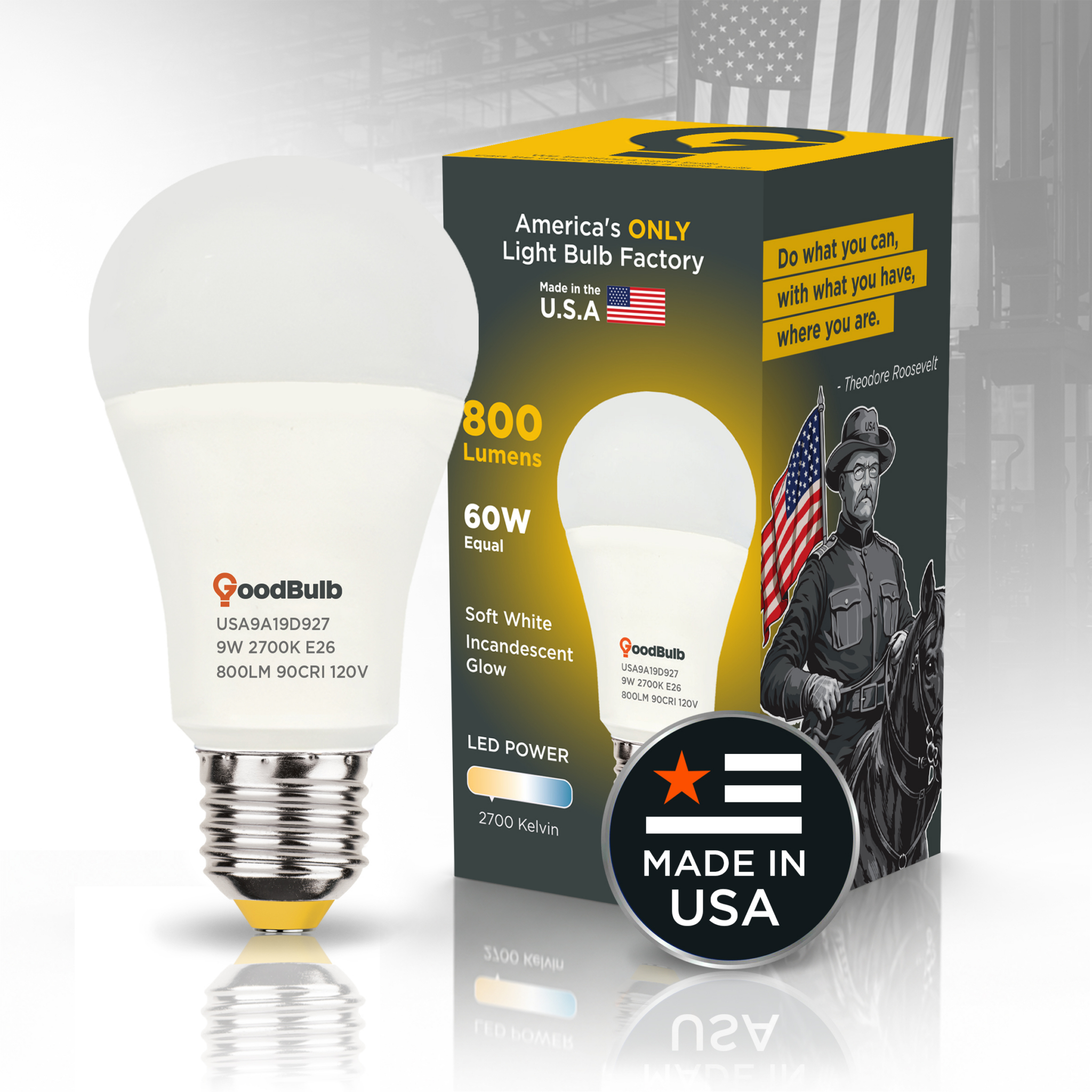
The factory currently produces standard A19 household LED bulbs in four color temperatures and both 60-watt and 100-watt equivalent models.
Enright believes his operation is unique.
“I know I am the only factory manufacturing the LED A19 in America,” said Enright. “I don’t know of another factory making lightbulbs at all in America.”
The production line currently manufactures about 8,000 bulbs during a single shift, although Enright says the equipment is designed to exceed 10,000 bulbs per shift and eventually produce roughly 30,000 bulbs daily at full capacity.
Perhaps most remarkably, three people can operate the entire line.
“You only need three people to run the entire line,” he said. “Overseas, they’re still probably using 20 people for that. That is the reason the major brands failed to bring this back. They tried to do it the same way it’s being done over there.
Enright says GoodBulb’s focus is not only domestic manufacturing but durability. Most imported consumer LED bulbs are rated between 5,000 and 15,000 hours, he said. GoodBulb’s bulbs are rated for 25,000 hours with a high color rendering index (CRI) designed to produce more natural-looking light.
“On day one we decided to make our bulb as long as it lasts today — 25,000 hours,” he said. “I am really confident that in the future we will be able to make this bulb last even longer.”
He points to the lighting industry’s history of “planned obsolescence,” citing the historic Phoebus Cartel, whose major players agreed to standardize shorter incandescent bulb lifespans.
“Too many products are made to fail,” Enright said. “With that philosophy, making lightbulbs to fail has been a part of lighting for the last 100 years.”
While GoodBulb assembles much of its product in Fargo, key electronic components such as LED chips and drivers must still be imported because no domestic suppliers currently manufacture them.
Enright hopes to change as much of that equation as possible, explaining Phase Two of the factory will add equipment to manufacture the plastic diffuser, bulb body and base in-house.
“We’ll be making more and more of the bulbs here, piece by piece,” he said.
One of the essential pieces that Goodbulb already manufactures is the tiny circuit boards found in each bulb. Enright said the circuit board manufacturing was one of the big reasons the factory is pristine and airtight.
“We made it a static free environment because of the LED circuit board manufacturing,” he said. “During this first phase, we are manufacturing the circuit boards. That is huge. We have our own circuits that we make here, and we redesigned the body of the bulb so that it lasts longer and provides better heat dissipation so it doesn’t get as hot and burn out so quick. We have a great dedicated team guiding this manufacturing.”
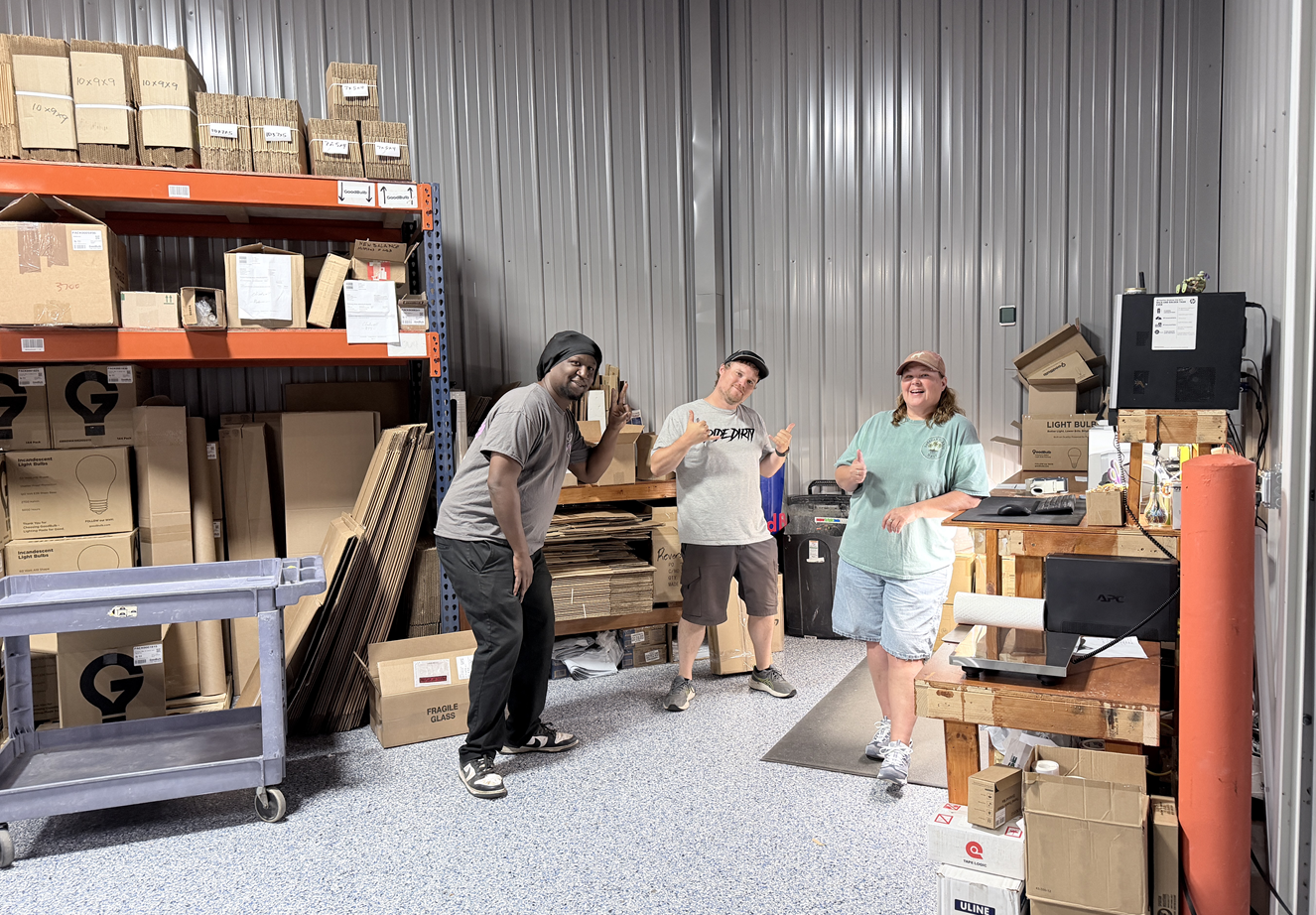
Employment has already grown from five people to nine, with plans to double and eventually triple the workforce as additional production lines come online.
GoodBulb currently sells bulbs primarily through its website in 10- and 40-packs while pursuing retail and electrical distribution partners nationwide.
Enright hopes his story demonstrates that advanced manufacturing can return to the United States when paired with modern automation.
“It took us eight years to build this first line,” he said. “I’ve written a playbook now. We can repeat it with a second, third and fourth line.”
Looking back, he admits there were moments of uncertainty.
“For a long time, we were taking baby steps,” Enright said. “It took a long time to get here. There were times when I doubted it, but I just kept going.”
Quite the story for the former door-to-door salesman who ignored advice not to sell lightbulbs.
The Alliance for American Manufacturing does not receive a commission from purchases made through the above links, nor was the organization or author paid for favorable coverage.
Labeling Note: This story is intended to highlight companies that support American jobs and that make great products in the United States. We rely on the companies listed to provide accurate information regarding their domestic operations and their products. Each company featured is individually responsible for labeling and advertising their products according to applicable standards, such as the Federal Trade Commission’s “Made in USA” standard or California’s “Made in USA” labeling law. We do not review individual products for compliance or claim that because a company is listed in the guide that their products comply with specific labeling or advertising standards. Our focus is on supporting companies that create American jobs.
For more on the Federal Trade Commission’s standards for “Made in USA” claims and California’s “Made in USA” labeling law, please also read this guest post by Dustin Painter and Kristi Wolff of Kelly Drye & Warren, LLP.