
The threat of U.S. tariffs has already caused some foreign governments to crack down on the circulation of unfairly made goods in their own markets.
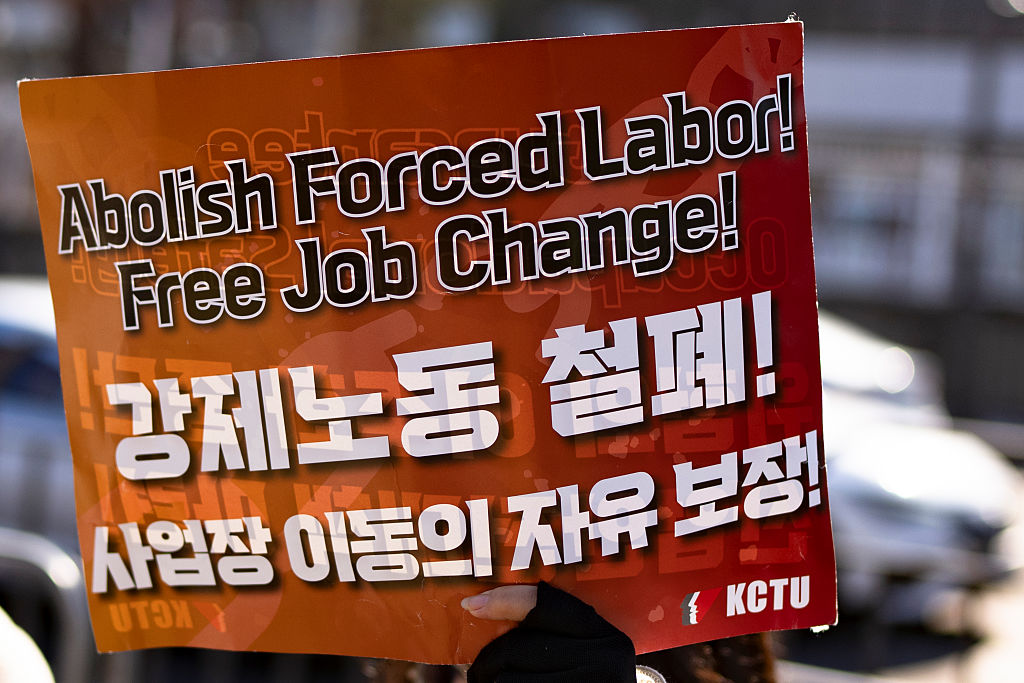
Much is made today of the inability to work across the political aisle and reach common ground. Yet, left and right, workers and employers in the United States have come to the same place, one that agrees on the importance of the domestic manufacturing sector and the great sin of forced labor. We should keep that agreement in mind when considering the Trump administration’s Section 301 tariffs that disincentivize the movement of goods made with forced labor through markets around the world.
The concept of forced labor is universally loathed and it is a human rights problem. And it is also a trade-distorting practice that artificially suppresses labor costs, undercuts law-abiding manufacturers and disadvantages workers and companies that follow the rules.
That is why the Uyghur Forced Labor Prevention Act (UFLPA) passed Congress with almost universal support five years ago. This law protects the jobs of American workers by taking a human rights approach to foreign affairs and our trade policy. The UFLPA establishes a rebuttable presumption that goods made wholly or in part with forced labor in China’s Xinjiang region are inadmissible to the United States. It means the U.S. will not expose its workers to competition that uses supply chains built on forced labor.
However, as leadership of the House Select Committee on China has previously noted, there is an urgent need to strengthen the law’s enforcement. Yes, the UFLPA is on the books and has proven to work; U.S. Customs and Border Protection (CBP) has detained and excluded numerous shipments under its authority. Imports subject to the UFLPA have declined in recent years, suggesting that enforcement is effective when applied consistently. Publicly available data shows that, during the final four months of Fiscal Year 2022, CBP stopped approximately $471 million worth of imports under UFLPA authorities. The value of stopped shipments increased to roughly $1.42 billion in FY 2023 and $1.77 billion in FY 2024 before falling sharply to $186 million in FY 2025. This year the sum is on pace to reach only around $300 million.
There is a real cost to that: Failure to fully enforce the UFLPA means a person in Xinjiang may be forced to work under inhumane conditions. And the profiteers and perpetrators of the exploitation of a worker abroad are the same ones who would exploit a worker anywhere.
Meanwhile, the new round of tariffs, announced by the Trump administration in July 2026 under the authority of Section 301 of the Trade Act of 1974, broadens the set of tools beyond the UFLPA’s import enforcement scope. Section 301 authorizes the United States Trade Representative (USTR) to investigate whether foreign acts, policies, or practices are unreasonable, discriminatory, or otherwise burden or restrict U.S. commerce. If a 301 investigation results in an affirmative finding, USTR is authorized to impose tariffs, negotiate binding agreements with foreign governments, or pursue other measures designed to eliminate the unfair practice and its burden on U.S. commerce. The findings of this 301 investigation concluded that foreign governments are not prohibiting and effectively enforcing bans on forced-labor imports. In short: USTR’s actions seek to ensure their markets and industries do not act as pass-throughs for products and inputs made wholly or in part by forced labor.
Why? Because, undeniably, the importation of goods made with forced labor unfairly burdens domestic manufacturers and workers by subjecting them to unfair competition.
Unfortunately, many companies and foreign governments view these tariffs and laws not as an opportunity to create a more just world, but rather as obstacles to circumvent. They do this by scattering production across different countries, manufacturers and subsidiaries, only then assembling and shipping the finished goods to the United States from a place that is not engaged in forced labor. Some companies can have as many as nine different tiers of production or suppliers and will often only engage with the first level, then letting that entity source from its own supplier and passing off responsibility down the chain. It is built-in plausible deniability, as companies can claim they do not know who or where the sub-suppliers are. This structure allows corporate decision makers to claim ignorance of labor abuses occurring deeper in their supply chains, without acknowledging their profits are gained via labor abuses in places like the Xinjiang region.
There is a shining example of that kind of behavior laid out in a May 2024 report prepared by Democratic staff on the U.S. Senate Finance Committee, which found multiple instances of auto parts and even entire vehicles presumed to have been made by forced labor in Xinjiang imported into the United States. Three major automakers – BMW, Volkswagen and Jaguar Land Rover – were connected to a “tier 3” manufacturer known as Sichuan Jingweida Technology Group (JWD), which relied on the forced labor of Uyghurs. As detailed in the report, BMW was aware of JWD’s alleged exposure to forced labor in 2020 yet claimed in 2022 it could not find a connection between itself and JWD. It was not until January 2024 that the company received written confirmation from its “tier 1” manufacturer, Lear, that tied BMW to JWD. Even then, BMW did not stop the import of JWD-made parts until April 2024.
The Committee’s work identified that VW and Land Rover had similar connections to JWD through Lear, yet also invoked the same defense of being initially unaware of the UFLPA violations in their supply chains.
“Somehow, the Finance Committee’s oversight staff uncovered what multi-billion-dollar companies apparently could not,” remarked Sen. Ron Wyden (D-Ore.) – the top Democrat on the Committee.
The same enforcement concerns will apply to the new 301 tariffs. Clear guidelines for CBP on how to apply the Section 301 tariffs to covered imports are needed, as is strict oversight to discourage circumvention. Still, there is a lot of promise in the 301’s results. This new round of tariffs incentivizes manufacturers and the countries that host them to crack down on their ties to forced labor in exchange for tariff relief, and it has already been productive: Within the last few weeks, Taiwan, South Africa, the Dominican Republic and Canada have made public declarations that they will ban imports into their own countries of goods and materials made using forced labor, and work with the U.S., to review their own administrative levers to maintain enforcement.
Tackling forced labor can help reverse decades of U.S. deindustrialization, which was spurred in part by poorly constructed free trade deals that incentivized the shipping of manufacturing jobs overseas in search of cheaper labor markets. In the United States, this has hollowed out communities built around manufacturing industries. Abroad, it has subjected workers to cycles of labor exploitation: When people working in these industries push back against abusive working conditions, they’re too often met with violence and coercion by the state and in 2022 abuse of workers reached record highs, according to the World Economic Forum.
These tariffs can help interrupt cycles of violence between employers and workers by inserting a significant penalty for turning a blind eye to inhumane conditions. And they are another lever to pull toward revitalizing the U.S. manufacturing sector, as companies are further disincentivized to move their factories abroad.
The fight against forced labor can be undertaken by all of us individually. Supporting U.S. manufacturers and buying American is a great, commonsense way to reduce exposure to products linked to forced labor; when you buy American, the materials and goods embedded in a final product are more likely to be held to vigorous labor standards. Your money goes into the pocket of an American worker, who can use it to pay their mortgage, buy groceries and spend it on their kids. Keeping U.S. dollars in the United States, cycling through the economy, generates tax revenue and profits that are then reinvested in local economies, creating a sustainable and ethical cycle of wealth creation.
The federal government, however, has a vitally important role to play here too: It must enforce the laws on the books and keep unfairly made goods from entering the U.S. market to compete with goods made by free and compensated workers. Whether it is the UFLPA or the new Section 301 tariffs, stamping out the sin of forced labor deserves our support.