

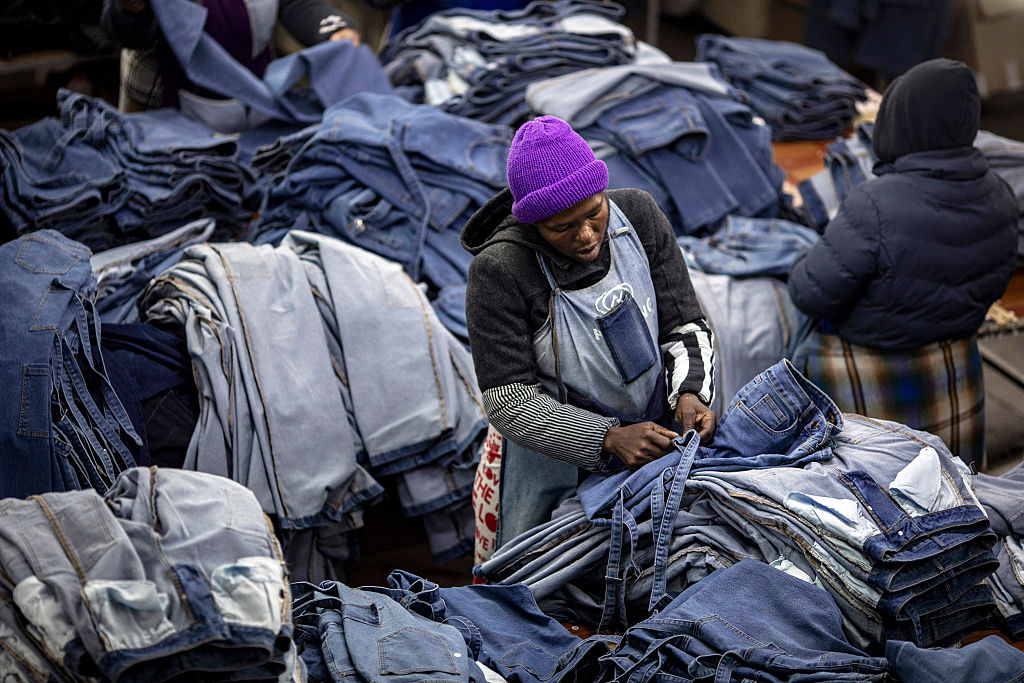
AAM argues that re-approving the legislation, which grants duty-free U.S. market access for hundreds of African products, should be paired with improved trade enforcement tools.
A big article this week in Sourcing Journal outlines apparel importers’ desires for a long-term reauthorization of the African Growth and Opportunity Act (AGOA), legislation first enacted in 2000 that provides eligible countries from sub-Saharan Africa (SSA) with duty-free U.S. market access for hundreds of products.
AGOA, which had been renewed in 2015, expired again in December 2025, and is now operating on a one-year renewal. Its next expiration comes in just a few months. And companies that bring in a lot of SSA apparel imports want the certainty of a multiyear extension.
They pitch AGOA as integral to developing industries in AGOA countries and to “boosting American textile exports and encouraging supply chain diversification away from China, where mounting costs, political risks and forced labor concerns have made sourcing increasingly fraught.”
But 25 years of AGOA’s preferential tariffs have not really built out the textile and apparel industries in these countries, notes Sheng Lu, a professor of fashion and apparel studies at the University of Delaware. Lu told the Journal that “that tariff preferences alone have not enabled SSA countries to develop the broader manufacturing capabilities necessary to compete with Asia at scale.” And if that’s the goal, the office of the United States Trade Representative, which sets AGOA eligibility criteria, should link eligibility to “demonstrable investment in domestic textile production, including yarn spinning, fabric weaving and dyeing and finishing.”
That seems sensible. If it’s undertaken, however, updating AGOA’s rules of origin (ROO) for many of these duty-free imports should be done in tandem. In a recent letter sent to USTR, which is soliciting public comments on AGOA as it preps recommendations for Congress on how to modernize the act, the Alliance for American Manufacturing (AAM) points out that “inputs produced in non-AGOA countries can be incorporated into products that undergo only limited assembly in an AGOA beneficiary country and are then exported to the United States duty‑free, undermining U.S. trade enforcement and disadvantaging domestic producers.”
AGOA’s ROO do not encourage investment in African industry, we write:
In practice, Chinese‑origin intermediate goods – such as fabric, yarn, or industrial inputs – are shipped to Africa, assembled into finished products with limited value added, and then re‑exported to the United States under AGOA preferences. While these products are nominally classified as African, the bulk of their value and supply chain control can remain outside the beneficiary country, often in China. Unsurprisingly, these lax rules of origin have enabled China to deepen its economic ties with Africa, a trend that runs counter to the economic alignment intended when AGOA was first enacted. China has been the continent’s largest trading partner for 16 consecutive years.
Indeed, an African industrial real estate executive told Sourcing Journal in 2024 that “in spite of having close to 2 million tons of cotton, 90 percent of the cotton has been exported to Asian countries—Bangladesh, Vietnam—for [Cotton Made in Africa] and other varieties of cotton, and hardly less than 5-10 percent of cotton being processed out there in Africa itself.”
Any trade deal or program, whether it’s the AGOA or the USMCA, should have rules or origin that benefit those who are party to the deal or the program, not third parties looking for a pass-through to the U.S. market.
ROO, however, isn’t the only concern that should be examined before Congress re-ups AGOA. Any effort on extending or facilitating more U.S. trade should come be paired with modernized U.S. trade enforcement tools – like the Leveling the Playing Field Act 2.0, which would make U.S. anti-dumping and countervailing duty tariffs more responsive, and the Fighting Trade Cheats Act, which would institute stronger penalties for customs fraud and repeat violators.
It should also be paired with the re-authorization of Trade Adjustment Assistance (TAA), an important federal program that helps workers whose factory jobs moved overseas as companies looked for cheap labor outside the United States. TAA provides financial subsidies for retraining, extended unemployment insurance benefits, job search assistance, and health coverage tax credits, and had been used by 5 million American workers since its inception in 1974 … until Congress let its funding lapse in 2022.
“Modernization of AGOA should therefore be paired with (TAA) to support workers affected by trade-related disruptions and ensure a more balanced approach to trade policy,” we write.
You can find our full comments here. That Sourcing Journal article delving into SSA apparel imports is here.