

Ever wondered where that crosshead screwdriver in your toolbox came from? Right here in the United States.
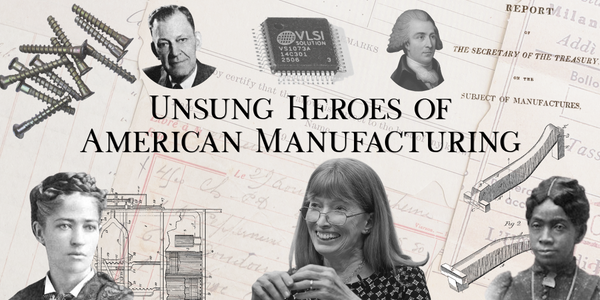
Welcome to the second installment of our new series, Unsung Heroes of American Manufacturing. If you read the first one, you should be an expert in the life of the woman who made ironing boards better for everyone. You can check it out here if you missed it. Following in her footsteps, our next inventor is known for mainstreaming another updated tool design: the Phillips screw and screwdriver.
Henry F. Phillips (1889-1958)
Even if you’re not a fan of building things (or taking them apart), you’re bound to have at least a couple screwdrivers at home. You need them to take the backs off battery-powered devices, attach that painting to the wall and fix that wobbly chair leg. There’s different types of screwdrivers, sure – but there’s one you reach for more than the rest. A classic American invention with its cross-shaped tip, the Phillips-head screwdriver (and the screws that go with it) can be found all over the world.
We have Henry F. Phillips to thank for that. Born in Missouri in 1889, Phillips spent most of his time as a businessman in Portland, Oregon before he changed the way we built things forever.
He didn’t design the original crosshead screw, though. That was done by an auto mechanic John P. Thompson, who, according to the Oregon Historical Society, granted his patents for the design directly to Phillips himself. Historians aren’t sure why this happened, and conflicting information exists surrounding whether Thompson tried to market the design on his own prior to working with Phillips. Regardless, Thompson’s patents for the screw in 1932 and its driver in 1933 were awarded straight to Phillips after being accepted.
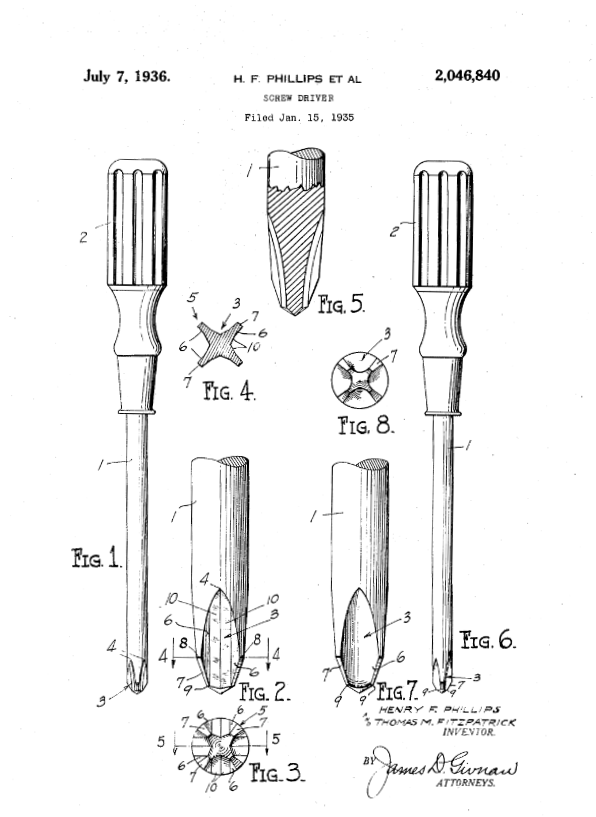
If the reports that Thompson’s design was of no interest to manufacturers are true, then Phillips must have been overly confident: He put his name on the design in 1933 by founding the Phillips Screw Company. By coincidence, it was right around this time that one of the United States’s largest screw manufacturers, the American Screw Company, experienced a change in leadership. The new president was a man named E.E. Clark, and Phillips was able to convince him that this new screw was a game changer.
By 1936, the design had gone through several changes and Phillips held around six new patents for the screw and its driver. When it became available for consumer use, General Motors started using the Phillips screws to build their popular Cadillac models. Not long after, other railroad, automobile and aviation industries began using the screws as well. Adjusted for inflation, Phillips’ company grossed over $1.3 million in 1940.
It wasn’t all success and profits, though – after Phillips retired as the head of his company in 1945 due to poor health, the U.S. government filed a lawsuit against the Phillips Screw Company. It accused the company (along with several other manufacturers of the screw who had allegedly formed a ‘patent pool’) of engaging in anti-competitive business practices, such as fixed prices and the suppression of competing technologies. A court ruled in 1949 to dissolve the patent pool, effectively stripping Phillips of his patent and allowing more universal production and competition of the screw.
Although Phillips died in Portland in 1958, his legacy lives on as the man who made manufacturing (and all our lives) quite a bit easier. The Phillips screw is still one of the most popular screw designs on the market, and the Phillips Screw Company continues to innovate based off the original design. The company still serves markets such as automotive, aerospace and industrial manufacturing, and license a diverse line of drive systems for countless uses. Next time you inevitably reach for that Phillips screwdriver that you’re pretty sure you’ve had since high school, think of the work of Henry Phillips and his confidence in the design’s capabilities. You’re holding a screwdriver that went from nothing to the most widely used drive system in the world – all thanks to American ingenuity.